Executive Threat Briefing:
Uber Impacts data breach has entered public disclosure after attackers compromised a third-party services provider and removed names, addresses, and driver license numbers tied to roughly 150,000 people. The Uber Impacts data breach does not involve a newly published CVE; the exposed control plane was delegated vendor access to support and verification records. RNT Infosec Security Analysts assess the incident as a supply-chain identity failure: stolen service credentials or bearer tokens gave a remote adversary data-plane read access without malware on Uber production endpoints. Containment centers on token revocation, vendor scope reduction, and rapid notification.
The investigation must preserve partner API logs, OAuth consent records, and export job metadata before retention windows expire. Enterprise response should treat the third-party provider as an untrusted identity boundary. Require mTLS, short-lived tokens, tenant binding, and anomaly detection on bulk record exports. Legal teams must evaluate multi-jurisdiction notification triggers while forensic teams enumerate every record touched by the compromised account.
Uber Impacts data breach: Third-Party Access and Incident Timeline
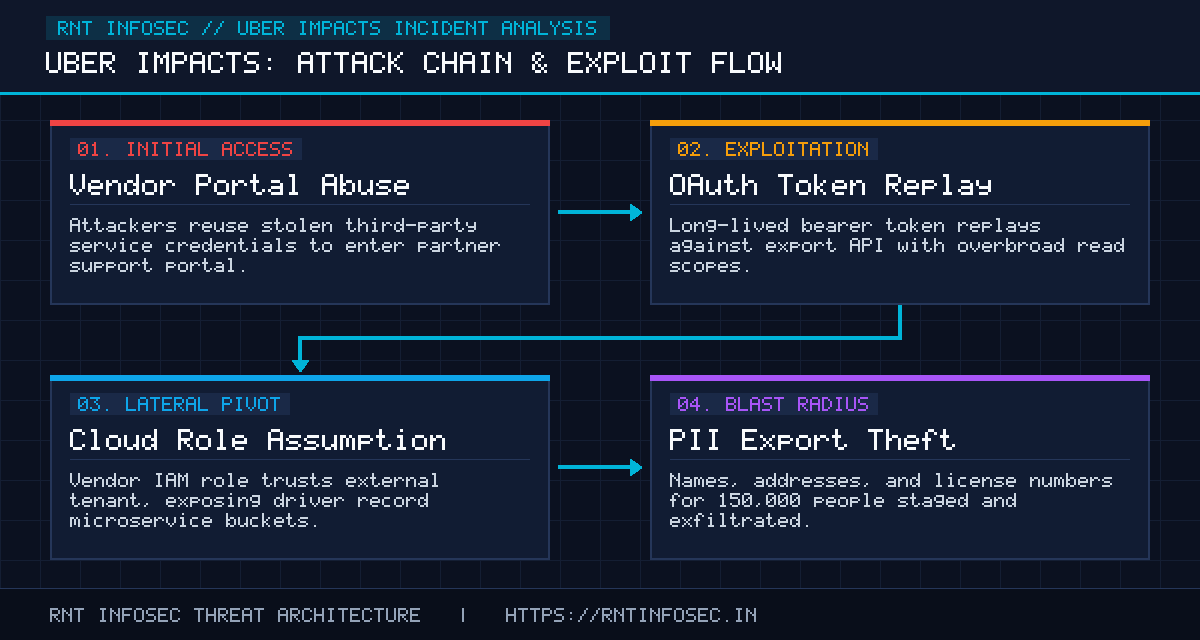
The reported timeline begins inside a third-party services provider, not at Uber’s public web tier. Attackers obtained credentials or an active session for a partner-facing support account, then used that delegated trust to query driver records. Public reporting identifies names, addresses, and driver license numbers for about 150,000 people. No CVE has been assigned because the evidence points to identity and authorization abuse rather than a memory-corruption exploit.
Forensic sequencing matters. A support portal login followed by export API calls is a high-confidence pattern for access-broker activity. The adversary did not need to defeat MFA at Uber if the vendor account already carried a valid refresh token. Log review should pivot on client_id, sub, src_ip, user_agent, and export job identifiers. The Uber Impacts data breach timeline should be reconstructed from IdP logs, API gateway logs, and vendor ticketing records, not press statements.
- T0: credential theft or token replay at vendor.
- T1: enumeration of /v1/records and export endpoints.
- T2: bulk archive of PII, followed by disclosure.
- MITRE T1078 Valid Accounts and T1528 Token Theft.
Exploit Anatomy and Root Cause Mechanics
Root cause is authorization design. The vendor integration appears to have granted broad read scopes to a service identity that could export records across tenants. A typical abused request would look like: GET /v1/support/records?limit=500&after=… HTTP/1.1, Host: partner-api.example, Authorization: Bearer eyJ…, X-Request-Id: 9f… . If the API trusts the bearer token without binding it to the originating tenant, device, or mTLS certificate, a stolen token becomes a portable data key.
Token replay is not a CVE. It is a control failure across OAuth scope grants, refresh-token TTL, and API gateway policy. The response body may return 200 OK with paginated records; the adversary pages through results until the export set is complete. Detection requires comparing token age, source ASN, and record volume against baseline. The Uber Impacts data breach attack surface was therefore contractual and identity-based, not a zero-day in public-facing code. NVD has no matching CVE record for this incident.
- Overbroad records.read and drivers.export scopes.
- Missing tenant claim validation in JWT.
- Refresh token TTL measured in days, not minutes.
- No mTLS pinning between partner and API.
Threat Actor Profile, Attribution and Adversary Tradecraft
No public attribution has been confirmed, and RNT Infosec Security Analysts discourage naming a group without telemetry. The operational pattern fits an initial access broker or data-extortion affiliate: steal delegated credentials, monetize records, and avoid noisy ransomware deployment. Dark web forums routinely advertise driver license data and support portal access as separate commodities. The absence of a CVE does not lower severity; it raises the value of identity logs.
Tradecraft includes credential harvesting from vendor employees, session cookie replay, and API enumeration. Historical campaigns against logistics and rideshare vendors use similar sequencing: phishing or infostealer malware at the supplier, then token abuse against the customer. The adversary’s toolmarks are likely mundane: browser session theft, curl or Python requests, and cloud storage staging. Attribution should rely on infrastructure overlap, wallet clustering, and malware family, not victim count. The Uber Impacts data breach pattern matches access brokerage followed by data extortion.
- Initial access broker activity at supplier.
- Infostealer logs and session replay.
- Data extortion without full ransomware.
- Residential proxies to blend API traffic; see CISA guidance.
Uber Impacts data breach attack vector: Privilege Escalation and Defense Evasion
Where the supplier endpoint was compromised, the attack vector likely combined token theft with host-based tradecraft. Attackers use rundll32.exe to proxy execution, certutil.exe to decode payloads, and archive utilities to stage exports. If EDR was present, they may have abused signed binaries and living-off-the-land techniques to avoid dropped executables. The Uber Impacts data breach attack vector is best modeled as credential access plus data-plane abuse, not a single exploit.
Token impersonation is the pivot. A stolen OAuth refresh token can be replayed from a new IP; if the IdP does not enforce device binding, the session appears legitimate. Memory injection into a browser process can also steal cookies and bearer tokens. Defenders should hunt for procdump.exe -ma lsass.exe, suspicious rundll32 command lines, and archive creation in vendor support hosts. EDR telemetry must retain parent-child process lineage and command-line arguments.
- T1055 Process Injection, T1134 Access Token Manipulation.
- T1218 Signed Binary Proxy Execution.
- T1562 Impair Defenses via security agent tampering.
- Hunt certutil -urlcache -f and 7z a -p.
Lateral Traversal, Cloud Infrastructure and Internal Enumeration
Inside the vendor environment, the adversary would enumerate cloud IAM roles and microservice endpoints. AWS CLI calls such as aws sts get-caller-identity, aws s3 ls, and aws secretsmanager list-secrets expose the blast radius. If the partner role trusted an external tenant, the attacker could assume that role and reach driver record buckets. The Uber Impacts data breach did not require Active Directory domain admin; cloud identity was the crown jewel.
Microservice discovery often begins with API gateway route lists and Kubernetes service accounts. The adversary maps /v1/drivers, /v1/records, and /v1/exports, then tests each with the stolen token. Horizontal movement is measured in API calls, not SMB sessions. Log sources must include CloudTrail, Kubernetes audit logs, and service mesh telemetry. Role assumption from an unexpected external account is the highest-fidelity signal.
- AssumeRole from unexpected external account.
- ListBuckets and GetObject on PII buckets.
- Kubernetes service account token theft.
- IdP enumeration via /oauth2/v1/userinfo.
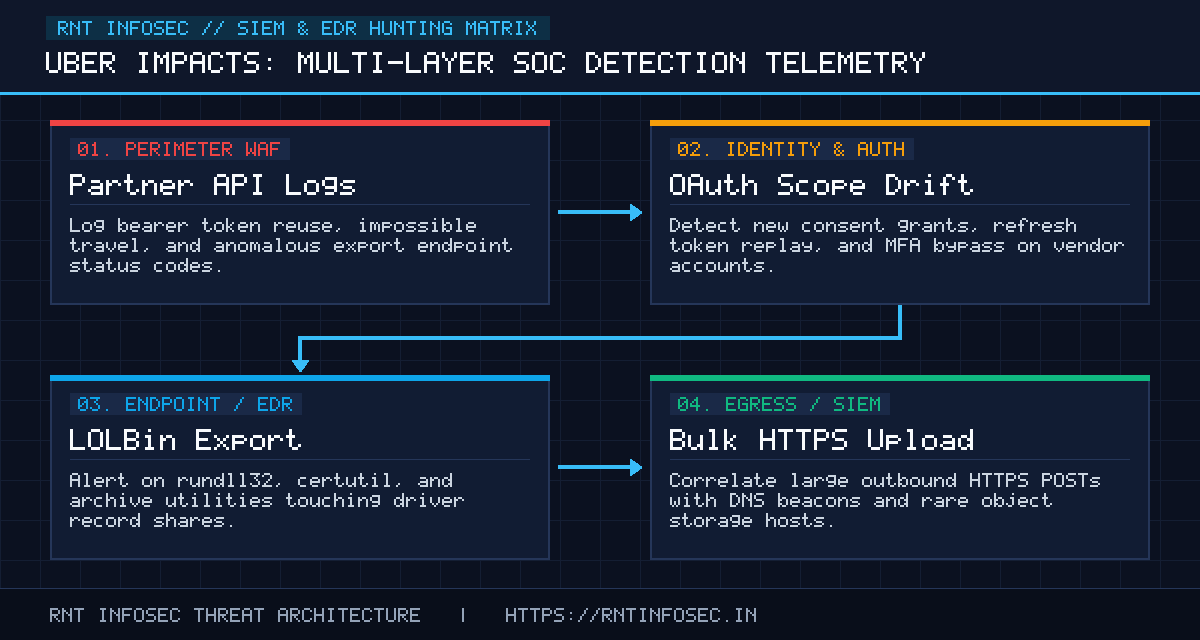
Uber Impacts indicators of compromise: Staging, Exfiltration, and Blast Radius
Data staging likely occurred in the supplier’s cloud tenancy. Attackers aggregate records into CSV or JSON archives, compress them, and upload to object storage or a VPS. Outbound channels include HTTPS POSTs to rare domains, DNS tunneling, and cloud storage APIs. The Uber Impacts data breach indicators of compromise include high-volume export calls, unusual User-Agent strings, and new OAuth consent grants.
Blast radius is 150,000 people with names, addresses, and driver license numbers. That combination supports identity fraud and account takeover. Third-party supply chain collateral risk extends to any customer using the same provider. Forensic scoping must identify every tenant whose records were reachable by the compromised account. Egress logs should be correlated with API export timestamps to identify the actual exfiltration window.
- GET /v1/exports spikes from one token.
- POST to *.r2.cloudflarestorage.com or unknown S3.
- DNS TXT query volume above baseline.
- New client_id consent for records.export.
Legal, Regulatory Compliance and Mandatory Disclosure Fallout
India’s DPDP Act 2023 Section 8(6) requires a data fiduciary to notify the Data Protection Board and affected data principals of a personal data breach. Section 33 penalty exposure can reach INR 250 crore for failure to prevent breach. CERT-In directions require incident reporting within six hours. The Uber Impacts data breach may trigger obligations at both the vendor and the customer if Indian residents are in the 150,000 population.
EU GDPR Article 33 requires controller notification within 72 hours; Article 34 requires communication to data subjects when high risk exists. US public companies must assess SEC Form 8-K Item 1.05 within four business days of materiality determination. SOC 2 and ISO 27001 audits will examine vendor risk, access review, and incident response evidence. Contractual processor terms must be checked for joint notification duties and indemnity triggers.
- DPDP Section 8(6) notice and Section 33 penalties.
- CERT-In 6-hour reporting.
- GDPR Art. 33/34.
- SEC 8-K Item 1.05.
Uber Impacts breach mitigation guide: Enterprise Remediation Controls
Immediate remediation starts with token revocation and scope reduction. Revoke all vendor refresh tokens, rotate API keys, enforce mTLS, and cap token TTL at 15 minutes for export APIs. ZTNA should require device posture and just-in-time approval. NIST CSF 2.0 PR.AA-01, DE.CM-01, and RS.MA-01 map directly to identity proofing, continuous monitoring, and incident response.
Micro-segmentation must isolate PII stores from partner support subnets. CIS Controls 3 and 6 require data classification and access management. The Uber Impacts data breach remediation cycle should include quarterly vendor access reviews, automated secret scanning, and egress allowlists. Treat every third-party integration as an untrusted identity that can be revoked in minutes. This Uber Impacts breach mitigation guide prioritizes revocation, scope reduction, and continuous verification over static contracts.
- Revoke tokens; rotate keys; enforce mTLS.
- Cap TTL; bind JWT to tenant and device.
- Egress allowlist for object storage.
- Quarterly access recertification.
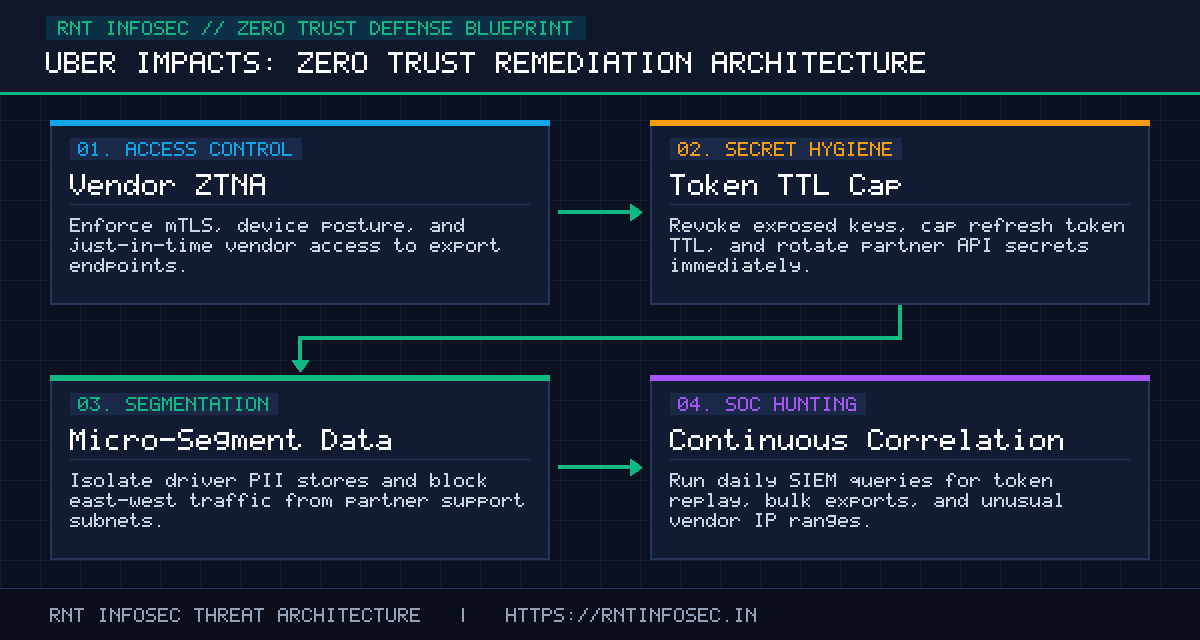
Threat Hunting, Detection Engineering and CISO Leadership Action Plan
SOC teams need production-ready hunts, not generic warnings. In Splunk, correlate OAuth and API logs by client_id and src_ip; alert when one token exports more than 5,000 records or 100 MB in an hour. Sigma logic should flag new consent grants for export scopes and rare ASN access to partner APIs. Elastic and CloudTrail queries should catch AssumeRole from external accounts.
Executive action is equally concrete. The CISO should direct a 24-hour token inventory, a vendor privilege freeze, and a board-ready materiality assessment. The Uber Impacts data breach shows that supplier identity is enterprise identity. Detection engineering must cover token replay, bulk export, and archive creation, not just malware hashes. Leadership should approve a 90-day control uplift with measurable exit criteria.
- Splunk: index=api (sourcetype=oauth OR sourcetype=partner_api) | stats count sum(bytes) by client_id src_ip | where count>5000 OR bytes>100000000
- Sigma: selection: event.action:consent.grant AND scope:*export*
- CloudTrail: eventName=AssumeRole AND userIdentity.accountId!=123456789012
- Hunt rundll32.exe and certutil.exe on vendor support hosts.
Intelligence Source: Original reporting by SecurityWeek. Reference: https://www.securityweek.com/uber-data-breach-impacts-150000-people/.
Frequently Asked Questions
What was the primary root-cause breach vector and credential abuse mechanics in the Uber Impacts data breach?
The primary vector is delegated access abuse at the third-party provider. Attackers obtained a valid service credential, session cookie, or OAuth refresh token and replayed it against partner APIs. The root cause is not a CVE; it is overbroad authorization, long token lifetime, and missing tenant or device binding. Review OAuth consent records, API gateway logs, and vendor identity logs to confirm which token crossed the boundary. Revoke all tokens issued to the affected integration before scoping the record count.
Was Uber production infrastructure isolated, or did attackers compromise client metadata?
Public reporting indicates the intruders compromised a third-party services provider and reached records through that trust path. RNT Infosec Security Analysts have no evidence in the disclosed facts that Uber production endpoint estate was isolated from the data theft; the distinction is between customer metadata and core ride infrastructure. Treat the vendor as the compromised enclave and Uber as the data controller or processor boundary. Preserve both vendor logs and Uber API logs for scope determination. Do not assume endpoint malware on Uber systems without forensic proof.
Which MITRE ATT&CK techniques align with the Uber Impacts data breach attack vector?
Assessed techniques include T1078 Valid Accounts, T1528 Steal Application Access Token, T1550 Use Alternate Authentication Material, and T1213 Data from Information Repositories. If supplier hosts were compromised, T1055 Process Injection, T1218 Signed Binary Proxy Execution, and T1562 Impair Defenses may also apply. Map each technique to a log source before writing detections. The Uber Impacts data breach attack vector aligns with credential access and collection, not destructive ransomware. Prioritize token replay and bulk export telemetry.
What immediate containment and emergency remediation actions should security teams take?
Containment requires revoking all refresh tokens and API keys for the affected vendor, disabling the integration, and forcing reauthentication with MFA. Add IP fencing and egress allowlists, reduce scopes to read-only minimum, and require mTLS. Freeze bulk export endpoints until anomaly detection is tuned. Preserve logs and snapshots before rotation. These actions shrink the Uber Impacts data breach blast radius while forensic scoping continues. Validate revocation across every cloud region and partner tenant.
What are the mandatory regulatory notification timelines under GDPR and India’s DPDP Act 2023?
Under GDPR Article 33, the controller must notify the supervisory authority within 72 hours of awareness unless the breach is unlikely to result in risk. Article 34 requires data-subject communication for high-risk exposure. India’s DPDP Act 2023 Section 8(6) requires notice to the Data Protection Board and affected persons; Section 33 carries penalties. CERT-In reporting is due within six hours. US issuers assess SEC Form 8-K Item 1.05 within four business days. Document materiality decisions in writing.
Which detection rules and threat hunting queries should SOC teams deploy for this campaign?
Build detections around identity and export behavior. Alert on one token exporting more than 5,000 records or 100 MB per hour, new consent grants for export scopes, impossible travel, and rare ASN access to partner APIs. Sigma should flag consent.grant events with *export* scopes. Splunk should correlate client_id, src_ip, user_agent, and bytes. CloudTrail should catch external AssumeRole and unexpected GetObject bursts. Tune against known vendor IP ranges and business hours. Retain queries as versioned detection-as-code artifacts.
Need Your Own Internal Security Team?
Cyber attacks and data breaches unfold in hours, not weeks. Safeguard your infrastructure, cloud assets, and sensitive customer data with RNT Infosec. Schedule a confidential consultation with our principal threat analysts today.