
Executive Threat Briefing: TSMC Employee data breach is now a confirmed identity-data exposure event after TSMC acknowledged that personal employee information leaked online and a criminal actor listed 6.9GB for auction. Public reporting connects the incident to a cloud provider, shifting the investigative focus to tenant isolation, OAuth token custody, and API authorization rather than a fab-floor intrusion. No CVE has been assigned, which matters: the root cause appears to be control-plane credential abuse and overbroad cloud permissions, not an unpatched remote code execution flaw. The immediate threat posture is elevated for suppliers, payroll processors, and identity providers that share employee metadata with TSMC. Attackers are monetizing HR and workforce data because it enables payroll diversion, recruiting fraud, and follow-on spear phishing. RNT Infosec Security Analysts assess that containment must prioritize token revocation, cloud audit-log preservation, and scoped IAM remediation before public attribution debates distract from evidence preservation.
Incident Timeline and Discovery of the TSMC Employee data breach
The TSMC Employee data breach surfaced through a criminal auction listing that advertised 6.9GB of allegedly stolen files. TSMC confirmed that personal employee data had leaked, moving the event from unverified forum chatter to a board-visible incident. Public reporting links the exposure to a cloud provider, so the first control failure sits in identity federation, API authorization, or object-storage permissions, not in wafer-fab operational technology.
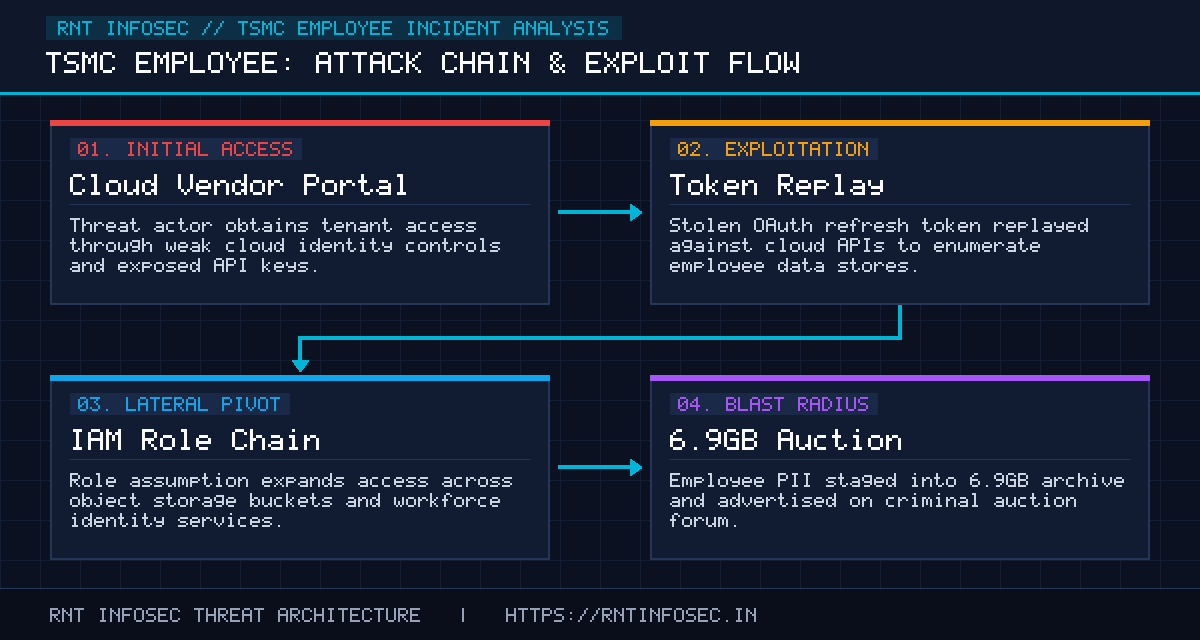
The chronology follows a familiar cloud extortion pattern: an initial access broker obtains tenant credentials or a refresh token, validates access against employee APIs, stages HR and payroll records, then advertises the archive. No CVE is identified in the public record, which points investigators toward misconfiguration and token lifecycle failures. Perimeter infiltration is therefore best modeled as unauthorized API use with valid credentials, where WAF signatures and CVE scanners provide little signal. The auction itself becomes an intelligence source: file counts, archive names, sample rows, and seller claims reveal the blast radius.
- Initial access: leaked cloud tenant credentials, long-lived OAuth refresh tokens, or exposed service-account keys.
- Discovery: auction listing advertises 6.9GB; TSMC confirms employee PII exposure.
- Containment: revoke tokens, rotate keys, preserve CloudTrail and IdP logs, notify regulators.
- Investigation: scope which employee records, payroll identifiers, and third-party metadata were exposed.
Exploit Anatomy and Root Cause Behind the TSMC Employee data breach
No NVD CVE anchors this case. The exploitable condition is an authorization gap: a cloud API accepts a bearer token whose scopes exceed the calling workload’s business need. A typical abusive request looks like GET /v1/employees?limit=500 with headers Authorization: Bearer eyJ…, X-Tenant-ID: tsmc-prod, and a stale User-Agent. If the API trusts tenant headers without binding them to the token audience, an attacker with one valid token can enumerate records across organizational boundaries.
The root cause pattern is long-lived refresh tokens, overbroad OAuth scopes such as directory.read.all or files.readwrite.all, and missing proof-of-possession. Response headers such as X-Request-ID and rate-limit counters help reconstruct enumeration speed. A JSON payload containing employeeId, fullName, department, and bankAccount fields is enough to drive fraud. Because no memory-corruption exploit is involved, EDR coverage alone cannot detect the TSMC Employee data breach; identity telemetry and API gateway logs become primary evidence.
- Token abuse: replay refresh tokens, change ASN, reuse same jti across geographies.
- Scope creep: directory, mail, HRIS, and storage scopes granted to a single integration app.
- Header weakness: tenant ID accepted from client rather than derived from token claims.
- Missing controls: no mTLS, no DPoP, no per-request risk scoring.
Threat Actor Profile, Attribution and Adversary Tradecraft
The actor behind the TSMC Employee data breach fits the financially motivated cloud data-theft cohort: no ransomware note, no destructive payload, just an auction listing and pressure to pay. These crews specialize in identity compromise, object-storage discovery, and HR data monetization. They often buy access from initial access brokers, then validate it with low-volume API calls before bulk export. Attribution remains provisional because auction personas are disposable and infrastructure overlaps with multiple extortion brands.
Tradecraft aligns with MITRE ATT&CK T1078 Valid Accounts, T1528 Steal Application Access Token, T1530 Data from Cloud Storage, and T1567 Exfiltration Over Web Service. The actor avoids noisy malware, preferring native cloud APIs and legitimate identity flows. Historical campaigns show the same pattern: steal a token, enumerate SaaS directories, stage archives, and publish sample records to prove access. Ransom demands are secondary; the auction model lets the seller monetize even if TSMC refuses to pay.
- Initial access broker activity precedes tenant enumeration.
- Dark-web auction samples include employee names, emails, departments, and payroll fragments.
- Toolmarks: cloud CLI calls, mass object reads, archive creation, new ASN logins.
- Extortion leverage: regulatory exposure, reputational damage, and employee phishing risk.
TSMC Employee data breach attack vector: Privilege Escalation and Defense Evasion
The TSMC Employee data breach attack vector is credential-centric. The actor does not need exploit code; valid tokens become the intrusion primitive. After replaying a refresh token, the adversary enumerates IAM roles, assumes a role with s3:GetObject or equivalent storage read permissions, and pivots into workforce data. Defense evasion focuses on blending with automation: steady request rates, approved user agents, and API calls during business hours. If endpoint staging occurs, LOLBins such as rundll32.exe, certutil.exe, and powershell.exe may compress or encode archives.
Endpoint evidence can include procdump.exe -ma lsass.exe for credential dumping, though cloud-only cases often lack it. Token impersonation may use Incognito or custom API hooking against LogonUser and DuplicateTokenEx. Security-agent tampering shows up as stopped EDR services, disabled event log channels, or deleted cloud audit trails. The defender’s problem is that each action is legitimate when viewed alone; correlation across IdP, API gateway, and EDR is required.
- T1078.004 cloud accounts; T1098 account manipulation; T1134 access token manipulation.
- Suspicious binaries: rundll32.exe, certutil.exe -urlcache, procdump.exe -ma lsass.exe.
- Audit-log tampering: Stop-Process on security services, cleared CloudTrail trails.
- Evasion signal: token replay from hosting ASN with browser-like user agent.
Lateral Traversal, Cloud Infrastructure and Internal Enumeration
Lateral movement in the TSMC Employee data breach is less about SMB pivots and more about role chaining. A compromised service account assumes an IAM role, reads environment variables, then uses instance metadata or secrets managers to reach another workload. In Kubernetes environments, stolen service-account tokens allow enumeration of namespaces, secrets, and config maps. Cloud storage becomes the aggregation point because HR exports, payroll snapshots, and identity logs frequently land in shared buckets.
On the identity side, attackers query Microsoft Graph, Okta, or Google Workspace for users, groups, devices, and OAuth grants. Active Directory enumeration may use net group /domain, nltest /domain_trusts, or LDAP queries for servicePrincipalName. The goal is not domain dominance; it is finding the shortest path to bulk employee data. Microservice discovery relies on API gateway routes, Swagger endpoints, and error messages that leak internal hostnames. Each discovery step increases the chance of inconsistent logging across tenants.
- Cloud: AssumeRole chains, secrets-manager reads, object-listing calls, snapshot exports.
- Kubernetes: service-account token theft, secret enumeration, pod exec into data processors.
- IdP: Graph /users, /groups, /oauth2PermissionGrants; Okta System Log searches.
- AD: net group /domain, nltest /domain_trusts, LDAP servicePrincipalName queries.
Data Staging, Exfiltration and TSMC Employee indicators of compromise
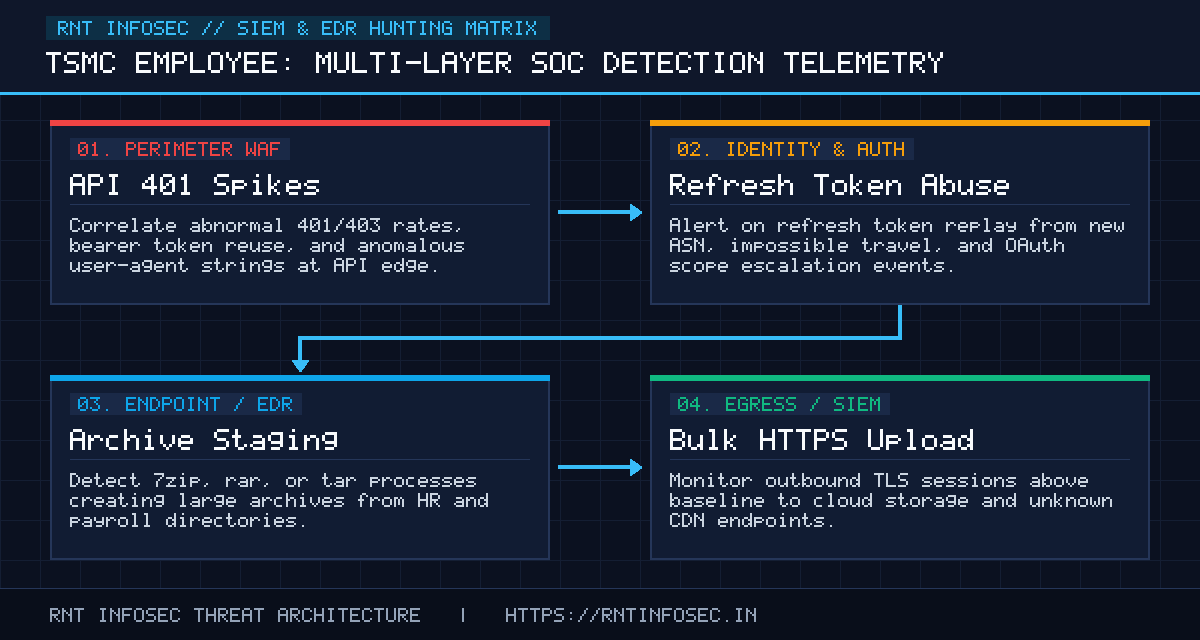
The TSMC Employee indicators of compromise center on bulk read and archive behavior rather than malware hashes. The actor aggregates CSV and JSON exports from HRIS, payroll, and directory services, then compresses them with 7zip, rar, or tar. A 6.9GB archive is large enough to contain hundreds of thousands of employee records but small enough to move over HTTPS in hours. Staging often occurs in a temporary bucket or compromised workstation before exfiltration.
Covert exfiltration uses allowed egress: HTTPS uploads to cloud storage, CDN fronting, or DNS tunneling when direct upload is blocked. Detectable artifacts include new TLS sessions to uncategorized ASNs, large POST bodies, unusual CloudFront or S3 PUT patterns, and DNS queries with high-entropy subdomains. Blast radius includes employee PII, payroll identifiers, and possibly customer contact metadata held by the cloud provider. Supply-chain collateral risk rises when the same identity provider serves contractors and partners.
- IoCs: 6.9GB archive, HR/payroll CSV exports, temp bucket names, new ASN logins.
- Network: high-volume HTTPS POST, DNS TXT/NULL queries, CDN-fronted uploads.
- Identity: refresh-token replay, new OAuth consent, mass Graph directory reads.
- Impact: employee phishing, payroll diversion, regulatory notification, partner risk.
Legal, Regulatory Compliance and Mandatory Disclosure Fallout
The TSMC Employee data breach triggers parallel notification clocks. Under India’s Digital Personal Data Protection Act 2023, Section 8(6) requires the data fiduciary to notify the Data Protection Board and affected data principals of a personal data breach; Section 33 permits penalties that can reach hundreds of crores of rupees. CERT-In directions require incident reporting within six hours of noticing. EU GDPR Article 33 requires controller notification to the supervisory authority within 72 hours, while Article 34 requires communication to data subjects when high risk is likely.
For US-listed issuers, SEC Form 8-K Item 1.05 requires disclosure of material cybersecurity incidents within four business days of determining materiality. SOC 2 and ISO 27001 audits will scrutinize access reviews, token lifecycle controls, and incident response evidence. Legal teams should preserve auction listings, CloudTrail logs, IdP logs, and forensic images. Public statements must avoid overclaiming containment before token revocation and scoping are complete.
- India DPDP Act 2023: Section 8(6) breach notification; Section 33 penalties.
- CERT-In: six-hour reporting mandate for cyber incidents.
- GDPR: Article 33 72-hour regulator notice; Article 34 data-subject notice.
- SEC: Form 8-K Item 1.05 four-business-day materiality disclosure.
TSMC Employee breach mitigation guide: Enterprise Defense Playbook
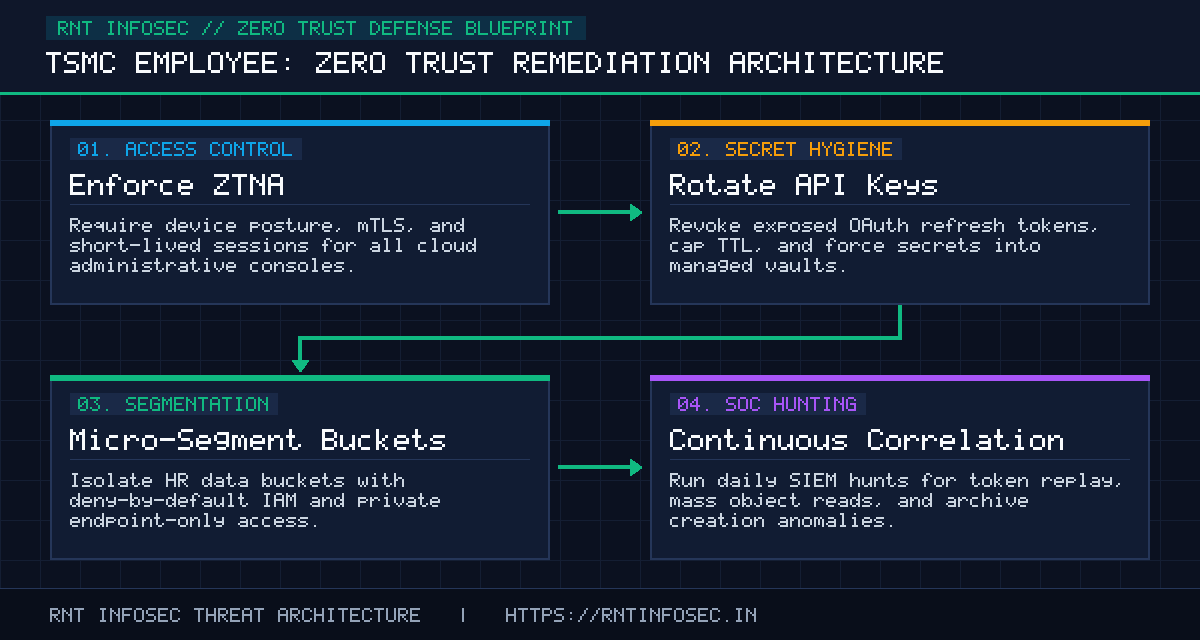
The TSMC Employee breach mitigation guide starts with identity containment, not perimeter patching. Revoke all refresh tokens for affected tenants, rotate service-account keys, and force reauthentication with phishing-resistant MFA. Map NIST CSF 2.0 PR.AA-01 for identity management and access control, DE.CM-01 for continuous monitoring, and RS.MA-01 for incident response execution. CIS Controls 3 and 6 reinforce data protection and access management. ZTNA with device posture checks reduces the value of stolen cookies and bearer tokens.
Enforce least privilege on cloud IAM: deny-by-default bucket policies, short token TTLs, workload identity federation, and per-request authorization. Micro-segment HR and payroll enclaves so a compromised integration cannot read finance or engineering data. Deploy secrets management with automatic rotation and alert on secret sprawl. Audit third-party OAuth grants quarterly and remove dormant apps. Incident response playbooks must include token revocation, IP fencing, scope reduction, and evidence preservation.
- Revoke tokens, rotate keys, enforce mTLS/DPoP, cap OAuth TTL.
- Apply deny-by-default IAM, private endpoints, and bucket-level logging.
- Micro-segment HR, payroll, and identity systems from general corporate networks.
- Validate controls with purple-team exercises and restore-test backups.
Threat Hunting, Detection Engineering and CISO Action Plan
SOC teams should hunt the TSMC Employee data breach with identity and API telemetry. A Splunk SPL query can correlate refresh-token use across ASNs: index=idp action=refresh | stats dc(src_ip) as ips values(src_ip) by user, app | where ips>2. CloudTrail hunting should flag AssumeRole followed by mass GetObject calls from a new principal. Sigma logic should alert on OAuth consent grants to unfamiliar applications and on archive creation in HR file shares.
CISO actions are sequence-sensitive: preserve logs, revoke credentials, scope data, notify regulators, then communicate. Do not let the auction listing dictate the investigation timeline. Validate whether the cloud provider’s shared-responsibility model leaves tenant configuration gaps. Require evidence of token revocation from every SaaS integration. RNT Infosec Security Analysts recommend a 30-day control sprint covering IAM reviews, secret rotation, egress monitoring, and tabletop notification exercises.
- Splunk: token replay, mass object reads, archive creation, unusual egress volume.
- Sigma: OAuth consent to new app, disabled MFA, new ASN login for privileged account.
- CloudTrail: AssumeRole, GetObject bursts, PutBucketPolicy, DeleteTrail.
- CISO: preserve evidence, revoke tokens, notify regulators, brief board.
Intelligence Source: Original reporting by BleepingComputer. Reference: https://www.bleepingcomputer.com/news/security/tsmc-employee-data-breach-linked-to-cloud-provider/.
Frequently Asked Questions
What was the primary root cause and token abuse mechanics in the TSMC Employee data breach?
Public evidence points to a cloud identity control failure rather than a CVE. The actor likely obtained a valid OAuth refresh token or service-account key, then replayed it against employee APIs. Overbroad scopes and weak tenant binding let one token enumerate HR records. Long token lifetimes and missing proof-of-possession increased the window. Defenders should treat refresh-token replay, new-ASN logins, and mass directory reads as the core mechanics. Revocation and scope reduction are the first containment steps.
Was only cloud infrastructure affected, or did client metadata leak?
TSMC confirmed personal employee data leaked, while public reporting links the exposure to a cloud provider. The available evidence does not indicate fab-floor OT compromise. Client metadata may still be exposed if the same tenant stored partner contacts, support tickets, or project files. Investigators must scope by data classification, not by server ownership. Treat any shared identity provider or file-sharing integration as potentially collateral until proven otherwise. Preserve logs and validate tenant boundaries before narrowing the notification scope.
Which MITRE ATT&CK techniques map to this incident?
The chain maps to T1078 Valid Accounts, T1528 Steal Application Access Token, T1530 Data from Cloud Storage, T1567 Exfiltration Over Web Service, and T1098 Account Manipulation. Endpoint staging may add T1003 OS Credential Dumping and T1059 Command and Scripting Interpreter. Defense evasion can include T1562 Impair Defenses if audit trails or security agents are tampered with. These mappings guide detection coverage and threat hunting priorities. SOC teams should verify each technique against available telemetry rather than assume full coverage.
What immediate containment actions should be taken?
Revoke all refresh tokens and session cookies for affected tenants, rotate service-account keys, and disable dormant OAuth applications. Fence suspicious ASNs at the identity and API gateway layers, then enforce step-up authentication for privileged users. Reduce token scopes to least privilege and enable mTLS or DPoP where supported. Preserve CloudTrail, IdP, WAF, and EDR logs before remediation changes evidence. Validate containment by replaying detection queries and confirming no new bulk exports occur.
What are the GDPR and DPDP Act notification timelines?
EU GDPR Article 33 requires controller notification to the supervisory authority within 72 hours of awareness, unless the breach is unlikely to result in risk. Article 34 requires communication to affected data subjects when high risk is likely. India’s DPDP Act 2023 Section 8(6) requires notification to the Data Protection Board and affected data principals; Section 33 authorizes penalties. CERT-In separately mandates incident reporting within six hours. Legal counsel should run these clocks in parallel with forensic scoping.
Need Your Own Internal Security Team?
Cyber attacks and data breaches unfold in hours, not weeks. Safeguard your infrastructure, cloud assets, and sensitive customer data with RNT Infosec. Schedule a confidential consultation with our principal threat analysts today.