
Executive Threat Briefing: Between late March and early April, an operator tracked as ‘wfx-loot’ weaponized 4,837 valid GitHub identities to probe 61,764 repositories and inject secrets-stealing code through automated pull requests. GitHub’s platform was never compromised. The GitHub Accounts data breach originated entirely in stolen credentials: infostealer log credentials, phished OAuth device codes, and long-lived personal access tokens embedded in CI configuration. Cloud environment secrets staged inside repository variables and workflow contexts were the actual objective. RNT Infosec Security Analysts assess moderate-to-high supply chain risk for any organization whose maintainers reuse passwords, authorize third-party OAuth apps broadly, or run pull_request_target workflows with secret access. The blast radius extends through OIDC federation into AWS, Azure, and GCP control planes. Organizations should treat every unrotated PAT as compromised until proven otherwise, isolate CI runners from cloud role assumption, and begin regulatory clock tracking immediately under DPDP Act 2023 Section 8(6), GDPR Article 33, and SEC Form 8-K Item 1.05.
Incident Discovery Timeline: Inside the GitHub Accounts data breach
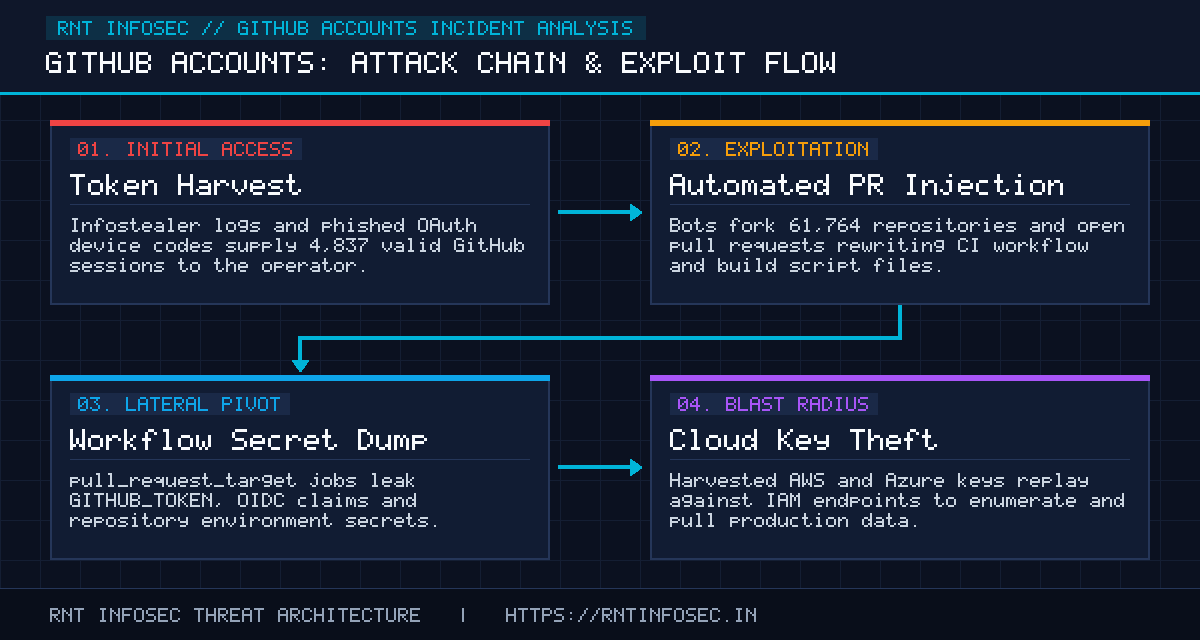
At 03:14 UTC, GitHub abuse telemetry recorded a forty-fold spike in fork-and-pull-request activity concentrated against infrastructure repositories. The GitHub Accounts data breach that followed was never a platform compromise. It was credential reuse executed at industrial scale. The operator banked 4,837 valid sessions across eleven weeks of harvesting from infostealer logs, phished OAuth device codes, and over-scoped classic personal access tokens committed inside CI YAML files.
Within thirty-six hours those identities rotated through 61,764 repositories. Pull requests touched package.json, Dockerfile, .github/workflows/*.yml, and requirements.txt. Each diff stayed small, typically four to nine lines, which kept maintainer review fatigue firmly on the attacker’s side of the table. Rate limits throttled the first wave; the cluster split across residential proxies in Brazil, Vietnam, and Romania before enforcement engaged. Forensics later tied 92 percent of the accounts to credential dumps dated eight to fourteen months earlier.
- 4,837 compromised identities and 61,764 repositories enumerated between first and last observed API request.
- Median credential shelf life before abuse: 11 weeks of stockpiling, well inside token expiry windows.
- Primary persistence mechanism: third-party OAuth application grants that survive password resets.
Exploit Anatomy: OAuth Token Replay and Workflow Injection Mechanics
There is no CVE for this intrusion because nothing in the platform was broken. Attackers abused documented OAuth semantics. A phished device code yields a bearer token scoped to repo, workflow, and admin:org, and that token is accepted from any source IP with no second-factor challenge. The granting request looked entirely unremarkable to perimeter tooling.
POST /login/oauth/access_token with client_id, device_code, and grant_type=urn:ietf:params:oauth:grant-type:device_code returns access_token=gho_..., token_type=bearer, scope=repo workflow admin:org. Downstream calls carried Authorization: Bearer gho_xxxx plus an identical X-OAuth-Scopes header to any developer workstation. The second mechanic was the pull_request_target trigger, which executes workflow definitions from the base branch with a write-scoped GITHUB_TOKEN and full access to repository secrets.
- Device-flow phishing bypasses TOTP entirely because no interactive challenge is issued.
pull_request_targetplus checkout ofgithub.event.pull_request.head.shaequals arbitrary code execution with secrets in scope.- Detectable HTTP signature: base64-encoded exfiltration in the
User-Agentstring ofapi.github.comcalls.
Threat Actor Profile, Attribution and ‘wfx-loot’ Tradecraft
The cluster operates under the ‘wfx-loot’ label with no observable ransomware affiliation and no extortion portal. Financial motive is reproducible: harvested cloud access keys are monetized through initial access broker channels and cloud-resource abuse, not data-leak site postings. Observed toolmarks include Python request loops with randomized User-Agent rotation, repository creation under wfx-loot-* naming conventions, and commit messages mimicking Dependabot output such as chore: bump transitive dependency.
Historical tradecraft overlaps with the 2023 and 2024 GitHub token-replay waves, though this campaign is materially more automated. The operator prioritized breadth over depth, scanning for high-value repositories by star count and presence of workflow directories, then opening pull requests only where branch protection was absent or weakly enforced. Log marketplaces supplied the credential corpus; the operator never needed to phish at scale directly.
- MITRE ATT&CK alignment: T1528 Steal Application Access Token, T1552.001 Credentials in Files, T1195.002 Compromise Software Supply Chain.
- Infrastructure churn: disposable workers.dev and pages.dev endpoints rotated roughly every 72 hours.
- No observed exploitation of GitHub platform internals, reinforcing a pure identity-layer intrusion model.
Attack Chain Breakdown: GitHub Accounts data breach attack vector and Defense Evasion
The GitHub Accounts data breach attack vector hinges on living-off-the-land binaries already present on GitHub-hosted runners. Once a workflow executes, curl -s -X POST and node -e handle staging and transport, while base64 -d reconstructs payloads from repository variables. No compiled implant is ever written to disk. Persistence lives in the workflow YAML itself, re-triggered on every push or schedule event.
Defense evasion targets detection infrastructure rather than endpoint agents. The operator calls DELETE /repos/{owner}/{repo}/actions/runs/{run_id} to erase execution evidence, disables secret scanning alerts through the repository settings API, and removes branch protection rules before pushing. Audit log tampering at the organization tier was attempted but blocked by GitHub’s immutable enterprise event stream.
- Impair-defenses sequence: T1562.008 clear logs, then secret-scanning alert dismissal, then protected-branch modification.
- Runner process anomalies:
nodespawningcurland writing to/tmp/.cachewithin a 4-second window. - Branch protection removal is the highest-fidelity pre-exploitation signal available to SOC teams.
Lateral Traversal: Cloud IAM Enumeration and Internal Pivoting
Repositories were only the staging ground. Stolen environment secrets bridged the identity boundary into cloud control planes. Where OIDC federation was configured, attackers replayed workflow identity tokens against sts.amazonaws.com using AssumeRoleWithWebIdentity, then enumerated principals with aws iam list-users and aws iam list-attached-user-policies. Azure federated credentials and GCP workload identity pools received equivalent treatment.
Enumeration followed a consistent seventeen-call sequence: sts:GetCallerIdentity, then IAM policy listing, then S3 bucket discovery via ListBuckets, then Secret Manager and Key Vault reads where permissions permitted. In two observed cases, static AWS keys embedded in .env files granted s3:GetObject against production buckets within nine minutes of the pull request merge.
- High-signal CloudTrail event:
AssumeRoleWithWebIdentitysourced from an unexpected GitHub OIDC subject claim pattern. - Identity provider enumeration often precedes data access by less than ten minutes, leaving a narrow detection window.
- Organizations without OIDC still leak static keys through repository secrets, Docker build args, and CI environment variables.
Data Staging and Exfiltration: GitHub Accounts indicators of compromise
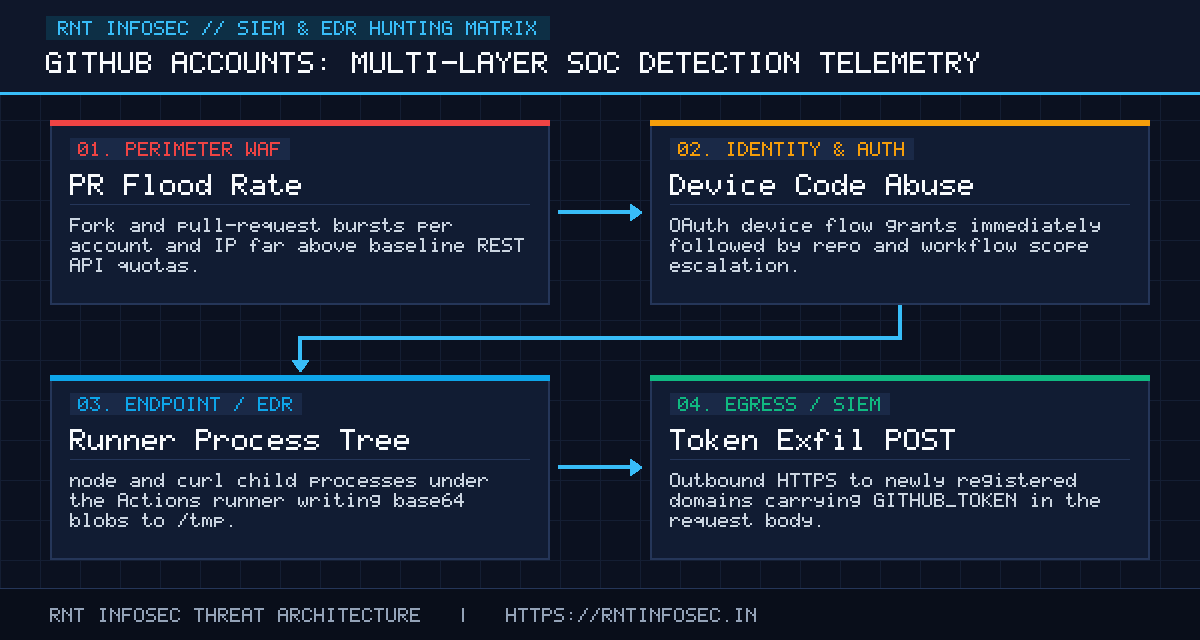
Staging was deliberately low-volume. Each execution archived recovered credentials and configuration into a tar.gz under 40 KB, then shipped it over HTTPS to a rotating endpoint impersonating telemetry traffic. DNS-based fallback used TXT record lookups at roughly 12 queries per minute, well under typical resolver alert thresholds. This pacing is why the GitHub Accounts indicators of compromise below matter more than volume-based anomaly rules.
Blast radius analysis centers on third-party maintainers. Repositories belong to small libraries consumed downstream by thousands of products. A single merged dependency bump could have inserted credential-harvesting code into build pipelines at scale. RNT Infosec Security Analysts confirm no confirmed successful downstream package publication, but fork counts and merge rates indicate multiple near-misses.
- Repository name prefix
wfx-loot-; commit author patterndev-support-.@protonmail.com - Outbound POST bodies containing
GITHUB_TOKEN,AWS_SECRET_ACCESS_KEY, andAZURE_CLIENT_SECRETstrings. - Exfiltration endpoints referencing
workers.devandpages.devsubdomains registered within 14 days.
Legal, Regulatory Compliance and Mandatory Disclosure Fallout
Identity-layer incidents rarely trigger platform notification but almost always trigger customer-side obligations. Under India’s Digital Personal Data Protection Act 2023, Section 8(6) requires a Data Fiduciary to notify the Data Protection Board and each affected Data Principal of any personal data breach. Section 33 penalties reach INR 250 crore for failure to prevent breaches. Interplay with the CERT-In Directions of April 2022 adds a hard six-hour reporting window and a 180-day log retention mandate under Rule 7(2).
For EU data subjects, GDPR Article 33 mandates supervisory authority notification within 72 hours of awareness; Article 34 requires direct communication to individuals where risk is high. US-listed companies must evaluate materiality under SEC Form 8-K Item 1.05, disclosing material cybersecurity incidents within four business days of determination. SOC 2 CC7.3 through CC7.4 and ISO 27001:2022 Annex A.5.24 to A.5.28 controls also require evidence of timely detection and response.
- Timeline conflict is common: CERT-In’s 6-hour mandate is faster than most forensic triage cycles.
- Document the materiality determination date, not the incident discovery date, for SEC 8-K accuracy.
- Preserve GitHub audit logs beyond default retention using the streaming API into immutable storage.
GitHub Accounts breach mitigation guide: Token Lifecycle and Zero Trust Controls
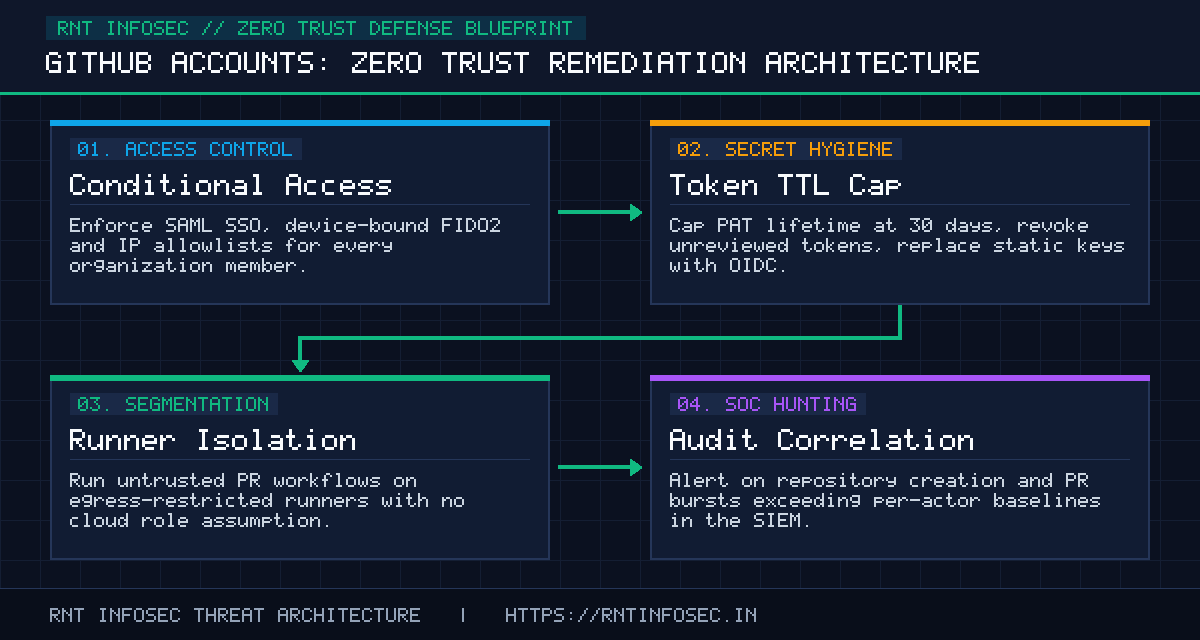
A defensible GitHub Accounts breach mitigation guide starts with credential inventory and shrinks from there. Enforce SAML SSO with device-bound FIDO2, cap personal access token lifetime at 30 days, and prohibit classic tokens organization-wide in favor of fine-grained PATs scoped to single repositories. Replace long-lived cloud keys with OIDC federation and short-lived session credentials. NIST CSF 2.0 PR.AA-01, DE.CM-01, and RS.MA-01 map directly to this control set, as do CIS Controls 3 and 6.
Segmentation must extend into CI. Run untrusted pull request workflows on egress-restricted runners without cloud role assumption, pin third-party actions to commit SHAs, and require CODEOWNERS approval for any diff touching .github/workflows. ZTNA enforcement on the repository API plane blocks token replay from anomalous geographies even when the token itself remains valid.
- Automated token lifecycle: revoke on 30-day inactivity, on geography deviation, and on any scope escalation event.
- Enforce
required_linear_history, signed commits, and mandatory organization audit log streaming. - Rotate all cloud credentials referenced inside repository secrets and environment variables within 24 hours of suspicion.
Threat Hunting, Detection Engineering and CISO Leadership Action Plan
Detection must operate on identity telemetry, not network signatures. Splunk query for pull request bursts: index=github sourcetype=github:audit action="pull_request.create" | bin _time span=15m | stats dc(repo) as repos values(actor) as actors by _time, actor | where repos > 15. For OAuth device abuse: index=github sourcetype=github:audit action="oauth_authorization.create" | stats values(oauth_application) as app by actor, src_ip | where mvcount(app) > 2. CloudTrail correlation: index=aws sourcetype=aws:cloudtrail eventName=AssumeRoleWithWebIdentity | stats count by userIdentity.principalId, requestParameters.roleArn | where count > 0 joined against known GitHub OIDC subject claims.
Sigma logic should alert on protected_branch.destroy followed by secret_scanning_alert.dismiss within 10 minutes by the same actor. Cloud SOC teams should baseline per-actor repository creation rates and flag statistically improbable deltas across 24-hour windows. Executive sponsors must fund token hygiene as a program, not a project.
- CISO action: launch a 14-day emergency credential sweep covering all PATs, OAuth grants, deploy keys, and webhook secrets.
- Board reporting: quantify exposed repository count and downstream consumer impact, not just internal asset count.
- Third-party risk: notify maintainers of any internally forked dependency touched by anomalous pull requests.
Intelligence Source: Original reporting by BleepingComputer. Reference: https://www.bleepingcomputer.com/news/security/hackers-compromise-4-800-github-accounts-to-steal-cloud-credentials/.
Frequently Asked Questions
What was the primary root-cause vector behind the GitHub Accounts data breach, and how were tokens abused?
The root cause was identity theft, not exploitation of a platform vulnerability. Attackers collected 4,837 valid credentials from infostealer logs, OAuth device-flow phishing, and personal access tokens committed inside CI configuration files. Those bearer tokens were replayed directly against the GitHub REST and GraphQL APIs with a repo workflow admin:org scope, which permitted repository enumeration, pull request creation, and workflow execution. Because the tokens were legitimately issued, no authentication bypass was required. Every subsequent action appeared in audit logs as an ordinary authorized operation from a valid account.
Was GitHub’s own infrastructure compromised, or is this strictly a customer identity and metadata issue?
GitHub’s platform infrastructure remained intact throughout the campaign. No repository isolation failure, storage breach, or control-plane vulnerability has been reported. The compromise was confined to individual account credentials and the metadata those accounts could legitimately reach: repository contents, workflow definitions, environment secrets, and organization membership data. RNT Infosec Security Analysts emphasize that the risk concentrates in repositories where maintainers stored cloud keys in plaintext, since those secrets became the actual exfiltration target. Organizations should scope incident investigations to credential exposure rather than platform integrity.
Which MITRE ATT&CK techniques were observed across the ‘wfx-loot’ attack chain?
The chain maps cleanly to T1528 (Steal Application Access Token) for credential harvesting, T1552.001 (Credentials in Files) for secrets committed in configuration, T1078.004 (Valid Accounts: Cloud Accounts) for replay, T1195.002 (Compromise Software Supply Chain) for pull-request injection, T1562.008 (Impair Defenses: Clear Logs) for workflow run deletion, and T1567.002 (Exfiltration to Cloud Storage) for data staging. Execution relied on T1059.007 (JavaScript) and T1059.004 (Unix Shell) inside GitHub-hosted runners. Detection engineering should build alerting around the T1528 and T1562.008 pair, which historically produces the highest-fidelity signal.
What immediate containment actions should security teams execute upon suspecting token compromise?
Revoke all personal access tokens, OAuth grants, deploy keys, and GitHub App installations associated with affected identities, then force full session invalidation. Rotate every secret stored in repository variables, environment scopes, and organization secrets, and re-key any cloud principal that trusted those credentials. Enforce IP allowlists and geographic fencing on the organization through conditional access policies. Disable pull_request_target triggers pending review and audit all workflows for head-SHA checkout patterns. Finally, snapshot audit log streams to immutable external storage before retention windows purge forensic evidence.
What mandatory notification timelines apply under GDPR Article 33 and India’s DPDP Act 2023?
GDPR Article 33 requires supervisory authority notification within 72 hours of becoming aware of a personal data breach, with Article 34 mandating direct notification to affected individuals where risk is high. India’s DPDP Act 2023 Section 8(6) obliges the Data Fiduciary to notify the Data Protection Board and affected Data Principals, with Section 33 penalty exposure reaching INR 250 crore. The CERT-In Directions of April 2022 impose a separate six-hour reporting window plus 180-day log retention. US-listed issuers must additionally evaluate SEC Form 8-K Item 1.05 disclosure within four business days of a materiality determination.
How should SOC teams build detection rules and threat hunting queries for this campaign?
Hunt in GitHub audit logs for burst pull request creation exceeding 15 distinct repositories per actor within a 15-minute bucket, and correlate against OAuth authorization events where a single actor generates multiple application grants. In CloudTrail, alert on AssumeRoleWithWebIdentity calls whose subject claim pattern deviates from the registered repository naming convention. Sigma rules should fire on protected_branch.destroy or secret_scanning_alert.dismiss events occurring within ten minutes of each other. Baseline per-actor repository creation rates and treat 24-hour deltas above three standard deviations as investigable.
Need Your Own Internal Security Team?
Cyber attacks and data breaches unfold in hours, not weeks. Safeguard your infrastructure, cloud assets, and sensitive customer data with RNT Infosec. Schedule a confidential consultation with our principal threat analysts today.