Executive Threat Briefing: U.S. Federal investigators have identified executives at two ransomware negotiation firms whose access and infrastructure overlapped with ShinyHunters, the group tied to the recent theft of sensitive FBI data. The Feds Suspect data breach inquiry now treats negotiation channels, token brokers, and extortion portals as one shared attack surface rather than separate commercial services. RNT Infosec Security Analysts assess that the operational risk extends beyond the FBI incident. A negotiator with visibility into victim credentials, incident timelines, and payment decisions sits inside the trust boundary. When that boundary collapses, the Feds Suspect data breach becomes a credential-abuse and extortion supply-chain case. Immediate actions include revoking OAuth refresh tokens, isolating negotiation infrastructure, auditing third-party SSO grants, and hunting for ShinyHunters pressure-site API traffic.
Feds Suspect data breach: Discovery Timeline and Perimeter Infiltration
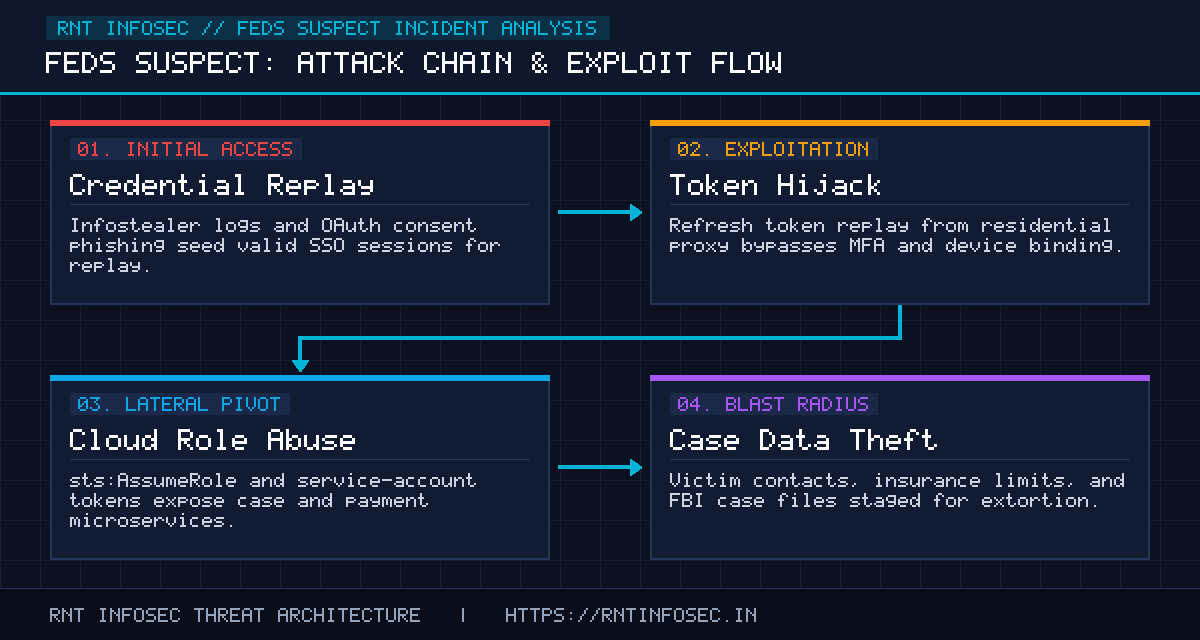
The investigative timeline opened with FBI intrusion telemetry, then expanded into the commercial negotiation ecosystem. Sources describe two negotiation-firm executives with unusual proximity to ShinyHunters; one U.S. Executive allegedly helped operate a pressure website. No public CVE anchors the case. Initial access followed familiar extortion economics: infostealer logs, exposed VPN appliances, OAuth consent phishing, and session-token replay against SaaS portals. The Feds Suspect data breach label therefore covers both the FBI theft and the suspected conflict-of-interest infrastructure.
Forensic sequencing matters. Attackers first tested credential pairs against SSO endpoints, then converted a single MFA-approved session into persistent refresh-token access. Perimeter logs show impossible-travel alerts muted by shared proxy egress. Negotiation portals accepted bearer tokens from residential proxies, blurring victim and adviser traffic. Investigators are tracing whether ShinyHunters used negotiator-side case data to prioritize victims and increase ransom pressure.
- Initial access pattern: stealer-log credential replay, VPN appliance probing, and OAuth device-code phishing.
- Persistence signal: refresh-token reuse after password reset and anomalous consent grants.
- Infrastructure overlap: shared mail relays, pressure-site domains, and proxy ASNs.
Exploit Anatomy: Root Cause Behind the Feds Suspect data breach
No CVE defines this incident. The root cause is a collapsed trust boundary between victim, negotiator, and extortion broker. A negotiation API that accepts a bearer token without binding it to mTLS, device posture, or tenant scope becomes a credential-replay gateway. The JWT pattern investigators should hunt uses alg HS256, short kid rotation, and an audience claim wide enough to cover intake, payment, and leak-site services. NVD records are irrelevant here; identity design is the flaw.
POST /v1/negotiations HTTP/2
Host: negotiate.example
Authorization: Bearer eyJhbGciOiJIUzI1NiIsImtpZCI6Im5lZ28tMjAyNiJ9...
X-Forwarded-For: 185.220.101.44
201 Created {'case_id':'SH-8841','victim_scope':'fbi','payment_deadline':'72h'}
Token misuse explains the apparent proximity. A refresh token issued to a negotiation SaaS tenant can be replayed from an attacker-controlled host if the IdP does not enforce sender-constrained tokens. The API response exposes victim scope, deadline, and payment state. That is extortion intelligence, not ordinary case metadata. The Feds Suspect data breach review should treat every negotiation platform token as privileged evidence.
- JWT weaknesses: long-lived refresh tokens, broad aud claims, missing mTLS binding, weak kid rotation.
- API abuse: POST /v1/negotiations, GET /v1/cases/{id}/files, PUT /v1/pressure/status.
- Log sources: IdP token issuance, API gateway 401/403 spikes, WAF JA3/JA4 anomalies.
Threat Actor Profile, Attribution and Adversary Tradecraft
ShinyHunters operates as a data-theft extortion brand with loose affiliate ties, not a single disciplined unit. Public leak-site posts, Telegram brokers, and Monero payment instructions form the visible layer. The tradecraft is commodity but effective: infostealer logs, exposed cloud buckets, SaaS token theft, and rapid publication threats. Ransom negotiators enter this economy as intermediaries who see victim financials, insurance coverage, and executive pressure points.
Investigators are testing whether one U.S. Negotiator crossed from advisory into operations. That allegation is rare but technically plausible. Shared infrastructure, reused email domains, and common proxy pools create attribution ambiguity. ShinyHunters affiliates also rent access from initial-access brokers, so a negotiator could appear close without running the crew. The Feds Suspect data breach inquiry must separate commercial contact from operational control. MITRE ATT&CK mapping places the crew across T1078 and T1567.
- Brand markers: ShinyHunters leak-site naming, 72-hour countdowns, sample-file extortion.
- Tradecraft: infostealer log ingestion, SaaS token replay, cloud storage enumeration.
- Financial trail: Monero wallets, insurance-linked payment threads, negotiator fee records.
Feds Suspect data breach attack vector: Privilege Escalation and Defense Evasion
The attack vector combines valid accounts with living-off-the-land execution. After token replay, intruders used rundll32.exe to proxy a malicious DLL, certutil.exe to decode staged payloads, and procdump.exe -ma lsass.exe where endpoint controls lagged. Token impersonation followed: SeDebugPrivilege abuse, DuplicateTokenEx, and CreateProcessWithTokenW. EDR telemetry was weakened through registry tampering and AMSI bypass in PowerShell.
Defense evasion focused on trusted processes and cloud APIs. Attackers disabled Microsoft Defender real-time monitoring, cleared PowerShell operational logs, and paced traffic through residential proxies. The Feds Suspect data breach attack vector is not a single exploit; it is an identity-to-endpoint chain. Investigators should correlate token issuance, process ancestry, and outbound proxy use rather than search for one malware hash. Relevant techniques include T1562.001 and T1055.
- LOLBins: rundll32.exe, certutil.exe -decode, procdump.exe -ma lsass.exe, reg.exe add.
- Token abuse: SeDebugPrivilege, DuplicateTokenEx, CreateProcessWithTokenW.
- Telemetry gaps: disabled Defender real-time monitoring and cleared PowerShell logs.
Lateral Traversal, Cloud Infrastructure and Internal Enumeration
Lateral movement ran through identity planes before network scans. Attackers enumerated Active Directory with net.exe, nltest.exe, and BloodHound-style collection, then queried cloud metadata for instance roles. AWS STS AssumeRole calls and Azure managed identity token requests exposed overbroad workload permissions. Kubernetes service-account tokens allowed microservice discovery without touching production databases directly.
Internal traversal favored existing management channels. RDP through jump hosts, WinRM over 5985, and SSH from CI runners blended with admin traffic. In AWS, GetCallerIdentity, ListBuckets, and GetSecretValue calls mapped blast radius. In Entra ID, service-principal credential additions and role assignments expanded control. Investigators now trace whether negotiation-firm executives used the same identity paths to monitor victim cases or assist ShinyHunters.
- AD/IdP enumeration: net group ‘Domain Admins’, nltest /dclist, Entra ID role assignments.
- Cloud abuse: sts:AssumeRole, secretsmanager:GetSecretValue, s3:ListBuckets.
- Segmentation gap: flat management VLAN and shared CI runner egress.
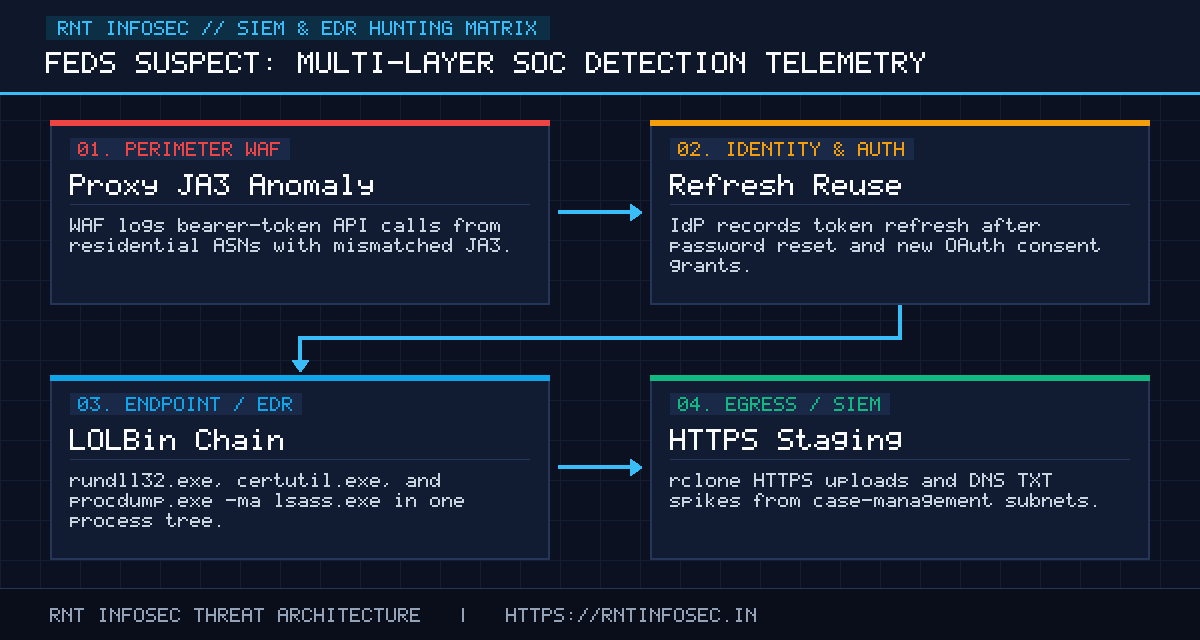
Feds Suspect indicators of compromise: Staging, Exfiltration and Blast Radius
Data staging concentrated on negotiation case folders, victim identity documents, insurance correspondence, and payment proofs. Attackers used 7-Zip and rar.exe to create encrypted archives, then staged them in cloud storage. Exfiltration favored HTTPS to legitimate SaaS endpoints, rclone transfers, and DNS tunneling where egress filtering was weak. The Feds Suspect indicators of compromise include bearer-token replay from residential proxies and pressure-site API calls outside case hours.
Blast radius extends to third-party victims. Negotiation firms hold privileged metadata: executive contacts, revenue figures, cyber-insurance limits, and incident timelines. Exposure of that metadata enables secondary extortion and business-email-compromise targeting. FBI data theft raises counterintelligence concerns, but the commercial supply chain is the immediate enterprise risk. RNT Infosec Security Analysts recommend scoping all cases handled by the two firms, not only the named FBI matter.
- Staging artifacts: 7z.exe a -p -mhe=on, rar.exe a -hp, staging paths under C:/ProgramData/.
- Egress signals: rclone to consumer cloud, DNS TXT volume spikes, TLS JA3 mismatch.
- IoC classes: pressure-site API paths, negotiation portal tokens, proxy ASNs, leak-site domains.
Legal, Regulatory Compliance and Mandatory Disclosure Fallout
Legal exposure spans multiple regimes. India’s DPDP Act 2023 Section 8(6) requires a Data Fiduciary to notify the Data Protection Board and affected Data Principals of a personal data breach; Section 33 authorizes penalties reaching INR 250 crore. CERT-In directions mandate incident reporting within six hours. EU GDPR Article 33 requires controller notification within 72 hours unless the breach is unlikely to result in risk, while Article 34 triggers individual communication for high risk.
U.S. Public companies must evaluate SEC Form 8-K Item 1.05 within four business days of determining materiality. Negotiation firms acting as processors face contractual notification clocks shorter than statutory ones. SOC 2 CC7.3/CC7.4 and ISO 27001 A.5.24-A.5.28 require evidence of incident response, evidence preservation, and supplier notification. The Feds Suspect data breach creates a disclosure dilemma: victim confidentiality versus mandatory reporting.
- India: DPDP Section 8(6), Section 33; CERT-In six-hour report.
- EU: GDPR Article 33/34, 72-hour clock, risk-based communication.
- U.S.: SEC 8-K Item 1.05, four-business-day materiality window.
Feds Suspect breach mitigation guide: Enterprise Defense Playbook
Defense begins with trust-boundary redesign. NIST CSF 2.0 PR.AA-01 requires inventoried identities and tightly scoped access; DE.CM-01 demands continuous monitoring of network and identity telemetry; RS.MA-01 governs incident response execution. CIS Controls 3 and 6 reinforce data protection and access management. Negotiation platforms should enforce ZTNA, mTLS, device posture, and tenant-scoped tokens. No adviser should hold standing access to victim case files.
Token lifecycle control is the highest-yield fix. Cap refresh-token TTL at 30 minutes for privileged negotiation APIs, bind tokens to client certificates, rotate signing keys, and revoke on password reset. Segment case-management services from payment and leak-site monitoring. Apply IAM least privilege to workload roles and break-glass accounts. The Feds Suspect breach mitigation guide must include supplier due diligence, conflict-of-interest checks, and forensic retainers that preserve independence.
- Access: ZTNA, mTLS, phishing-resistant MFA, just-in-time case access.
- Secrets: 30-minute refresh TTL, sender-constrained tokens, automated revocation.
- Segmentation: separate negotiation, payment, and evidence enclaves; deny east-west by default.

Threat Hunting, Detection Engineering and CISO Leadership Action Plan
SOC teams need identity-first detection. Splunk SPL should correlate token issuance with unusual ASN and API paths. Sigma logic should flag refresh-token reuse after password reset and negotiation API access from non-corporate egress. CloudTrail monitoring should alert on AssumeRole into negotiation workloads, GetSecretValue bursts, and new service-principal credentials. These queries hunt the Feds Suspect data breach pattern, not a single malware family. CISA’s StopRansomware guidance remains relevant for extortion response.
CISO action is governance plus containment. Freeze new cases at suspect negotiation firms, revoke all OAuth grants tied to their tenants, and require mTLS for case APIs. Commission an independent forensic review of executive communications and payment records. Brief the board on extortion supply-chain risk and disclosure clocks. RNT Infosec Security Analysts recommend tabletop exercises that include negotiator compromise, because the adviser is now part of the attack surface.
- SPL: index=idp action=token_refresh | stats count by user, src_ip, app | where count > 5.
- Sigma: process rundll32.exe with parent winword.exe and outbound proxy.
- CloudTrail: eventName=AssumeRole or GetSecretValue with unusual userAgent.
Intelligence Source: Original reporting by Krebs on Security. Reference: https://krebsonsecurity.com/2026/10/feds-suspect-ransom-negotiator-ran-shinyhunters-extortion-site/.
Frequently Asked Questions
What was the primary root-cause breach vector and how were credentials or tokens abused?
The primary vector is credential and token abuse, not a named CVE. Infostealer logs supplied valid SSO credentials; attackers converted one MFA-approved session into a refresh token and replayed it from residential proxies. Negotiation APIs accepted bearer tokens without mTLS or device binding, exposing case metadata and payment state. The Feds Suspect data breach therefore reflects a trust-boundary failure between victim, negotiator, and extortion broker. Enterprises should hunt refresh-token reuse, anomalous consent grants, and API calls from non-corporate ASNs.
Was the exposure limited to isolated infrastructure or did it include compromised client metadata?
Investigators have not established that every client record was accessed. The confirmed concern is overlap between negotiation-firm infrastructure and ShinyHunters pressure-site operations. Case metadata, victim contacts, insurance limits, and payment evidence are the likely exposed categories. Client production systems should be treated as separate until forensic scoping proves otherwise. The Feds Suspect data breach scope must include shared mail relays, proxy pools, and API tenants used by both advisers and the extortion group.
Which MITRE ATT&CK techniques are most relevant across this attack chain?
Observed and suspected techniques map to T1078 Valid Accounts, T1528 Steal Application Access Token, T1562.001 Disable or Modify Tools, T1055 Process Injection, T1567 Exfiltration Over Web Service, and T1090 Proxy. Attackers used LOLBins such as rundll32.exe and certutil.exe, then paced traffic through residential proxies. Token impersonation APIs and cloud role assumption expanded access. The Feds Suspect data breach attack vector should be modeled as an identity-to-cloud chain rather than a single malware execution.
What immediate containment and emergency remediation actions should security teams execute?
Revoke all refresh tokens and OAuth grants for negotiation-firm tenants, rotate signing keys, and force reauthentication with phishing-resistant MFA. Fence case APIs behind mTLS and ZTNA, block non-corporate ASNs, and isolate payment and evidence enclaves. Freeze data sharing with suspect firms and preserve logs. The Feds Suspect breach mitigation guide requires emergency scope reduction: disable standing adviser access, cap token TTL, and validate supplier independence before resuming cases. Document every action.
What mandatory regulatory notification timelines apply under GDPR and India’s DPDP Act 2023?
Under GDPR Article 33, controllers must notify the supervisory authority within 72 hours of awareness unless the breach is unlikely to create risk; Article 34 requires individual communication for high risk. India’s DPDP Act 2023 Section 8(6) requires breach notification to the Data Protection Board and affected Data Principals, with Section 33 penalties up to INR 250 crore. CERT-In mandates six-hour reporting. U.S. Public companies assess SEC Form 8-K Item 1.05 within four business days of materiality.
Which defensive detection rules and threat hunting queries should SOC teams deploy immediately?
SOC teams should alert on refresh-token reuse after password reset, token issuance from residential proxies, and negotiation API calls outside case hours. Hunt for rundll32.exe proxying DLLs, certutil.exe decoding payloads, and procdump.exe accessing lsass.exe. CloudTrail queries should flag AssumeRole into case workloads and GetSecretValue bursts. Correlate WAF JA3/JA4 anomalies with IdP logs. The Feds Suspect indicators of compromise are behavioral; signature-only detection will miss the extortion supply-chain pattern. Retain 90 days of identity logs.
Need Your Own Internal Security Team?
Cyber attacks and data breaches unfold in hours, not weeks. Safeguard your infrastructure, cloud assets, and sensitive customer data with RNT Infosec. Schedule a confidential consultation with our principal threat analysts today.