
Introduction
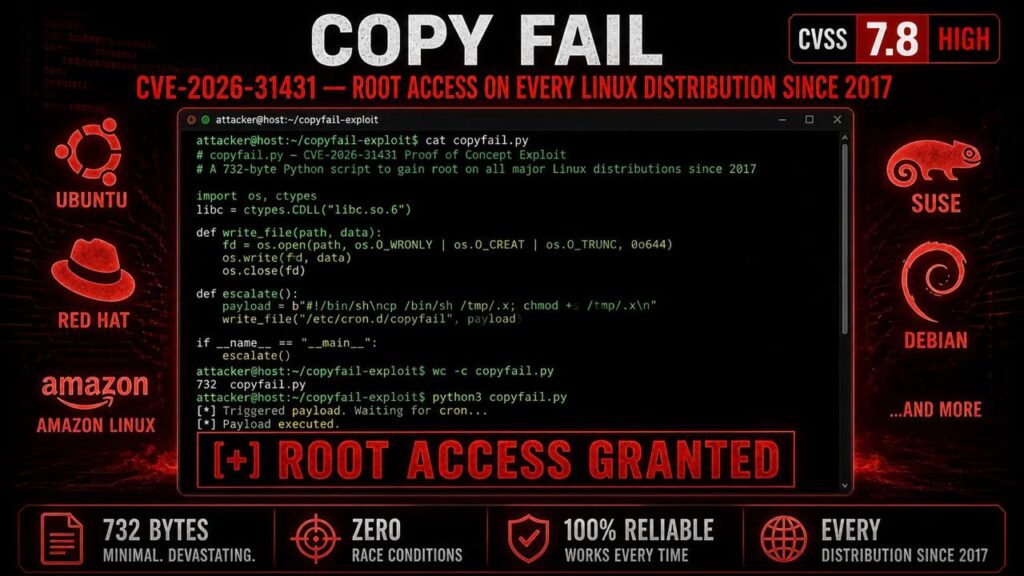
In the evolving landscape of cybersecurity, some vulnerabilities stand out not because of complexity—but because of their simplicity and impact. One such critical flaw is CVE-2026-31431, widely known as the “Copy-Fail” exploit.
Disclosed in April 2026, this vulnerability affects almost every major Linux distribution released since 2017, making it one of the most dangerous local privilege escalation flaws in recent years.
What makes Copy-Fail particularly alarming is its ability to allow any low-privileged user to gain full root access within seconds, using a very small exploit payload.
What is CVE-2026-31431 (Copy-Fail)?
Copy-Fail is a Local Privilege Escalation (LPE) vulnerability in the Linux kernel’s cryptographic subsystem (algif_aead).
At its core, the flaw allows an attacker to:
- Perform controlled memory corruption
- Modify page cache (in-memory file data)
- Inject malicious changes into privileged binaries
- Execute them to gain root-level access
Unlike traditional exploits, this vulnerability:
- Does not require complex race conditions
- Works reliably across distributions
- Leaves minimal forensic traces
Technical Root Cause
The vulnerability originates from a logic flaw introduced in 2017 within the Linux kernel.
Key Technical Points:
- Uses AF_ALG (crypto API interface)
- Abuses
splice()system call - Enables write operations into read-only page cache
Due to improper handling of memory:
- The kernel allows controlled 4-byte writes into cached files
- These changes do not get written to disk
- Security tools fail to detect the modification
👉 This results in stealthy privilege escalation
Exploitation Overview (Simplified)
The exploitation of CVE-2026-31431 (Copy-Fail) leverages a flaw in the Linux kernel’s memory handling to achieve privilege escalation. The attacker begins by interacting with the kernel’s cryptographic subsystem through the AF_ALG interface, establishing a controlled entry point into kernel operations. This allows the attacker to operate within a trusted execution path, which is rarely monitored by traditional security mechanisms.
Next, the attacker abuses the splice() system call to map a privileged binary, such as /usr/bin/su, into the system’s page cache. Instead of modifying the actual file on disk, the attacker targets its in-memory representation, which is managed by the kernel for performance optimization. This approach is crucial because it avoids triggering file-based security controls.
The core of the exploit involves performing a controlled modification within this cached memory. By exploiting insufficient validation, the attacker injects small but strategic changes into the binary’s execution logic, effectively bypassing security checks. When the modified binary is executed, the system unknowingly runs the altered in-memory version, resulting in immediate root-level access.
This technique is particularly dangerous because it operates entirely in memory, leaving minimal traces and making detection significantly more difficult compared to traditional file-based attacks.
A real exploit:(CODE)
- Bind AF_ALG socket
- splice target binary into memory
- overwrite specific bytes
- execute modified binary
- ~700 bytes Python script
- Works across multiple Linux distributions
- Requires no recompilation or version tuning
Why Copy-Fail is Extremely Dangerous
The “Copy-Fail” exploit (CVE-2026-31431) represents a terrifying evolution in cyber threats because it swaps the usual complexity of hacking for raw, deterministic reliability. Unlike traditional vulnerabilities that require perfect timing or complex chains, Copy-Fail allows any low-privileged user to seize root access in seconds with near-perfect consistency. Its true danger lies in its stealth: by manipulating the page cache—the system’s temporary memory—rather than the physical files on the disk, it effectively bypasses standard security monitors and antivirus tools that are looking for changes in the wrong place. Because this flaw lives deep within the Linux kernel, it creates a massive, silent attack surface across cloud servers, containers, and enterprise infrastructure, turning a “secure” system into an open door without leaving a single footprint on the hard drive.
Mitigation & Remediation
Addressing the risks associated with CVE-2026-31431 requires a combination of immediate patching and long-term defensive strategies. The most critical step is to ensure that all affected systems are updated to a patched version of the Linux kernel provided by the respective distribution vendors. Timely patch management remains the most effective defense against kernel-level vulnerabilities, and delays in applying updates can leave systems exposed to active exploitation.
In situations where immediate patching is not feasible, temporary mitigation measures can help reduce the attack surface. Restricting access to the AF_ALG interface and disabling vulnerable kernel modules can limit the exploit’s entry points. Additionally, enforcing strict security policies using mechanisms such as SELinux or AppArmor can provide an additional layer of protection by controlling how processes interact with system resources.
From a defensive monitoring perspective, organizations should shift towards behavior-based detection mechanisms rather than relying solely on signature-based tools. Monitoring unusual system calls, detecting abnormal privilege escalation patterns, and integrating endpoint detection and response (EDR) solutions can significantly improve visibility into such stealthy attacks. Ultimately, a layered security approach that combines patching, hardening, and real-time monitoring is essential to effectively mitigate this vulnerability.
Lessons for Security Professionals
The emergence of CVE-2026-31431 offers several important lessons for cybersecurity professionals, particularly those involved in penetration testing, red teaming, and system defense. One of the most critical takeaways is that severe vulnerabilities do not always stem from complex exploits; often, they arise from simple logic flaws that go unnoticed for years. This highlights the importance of deep code review, kernel-level testing, and continuous security research.
Another key lesson is the limitation of traditional security tools. Many organizations rely heavily on file-based detection mechanisms, assuming that any malicious activity will leave traces on disk. However, Copy-Fail demonstrates that attacks operating in memory can completely bypass such controls, emphasizing the need for more advanced, behavior-driven security models.
For red teamers, this vulnerability reinforces the value of exploring non-traditional attack surfaces, such as kernel interfaces and memory manipulation techniques. For blue teams, it underscores the importance of proactive defense strategies, including anomaly detection, threat hunting, and rapid incident response capabilities. Ultimately, Copy-Fail serves as a reminder that security is not just about preventing known threats, but about anticipating how systems can be misused in unexpected ways.